
NDIS Pricing Arrangements and Price Limits: What Participants, Families and Providers Need to Know
What Is the NDIS Pricing Schedule?
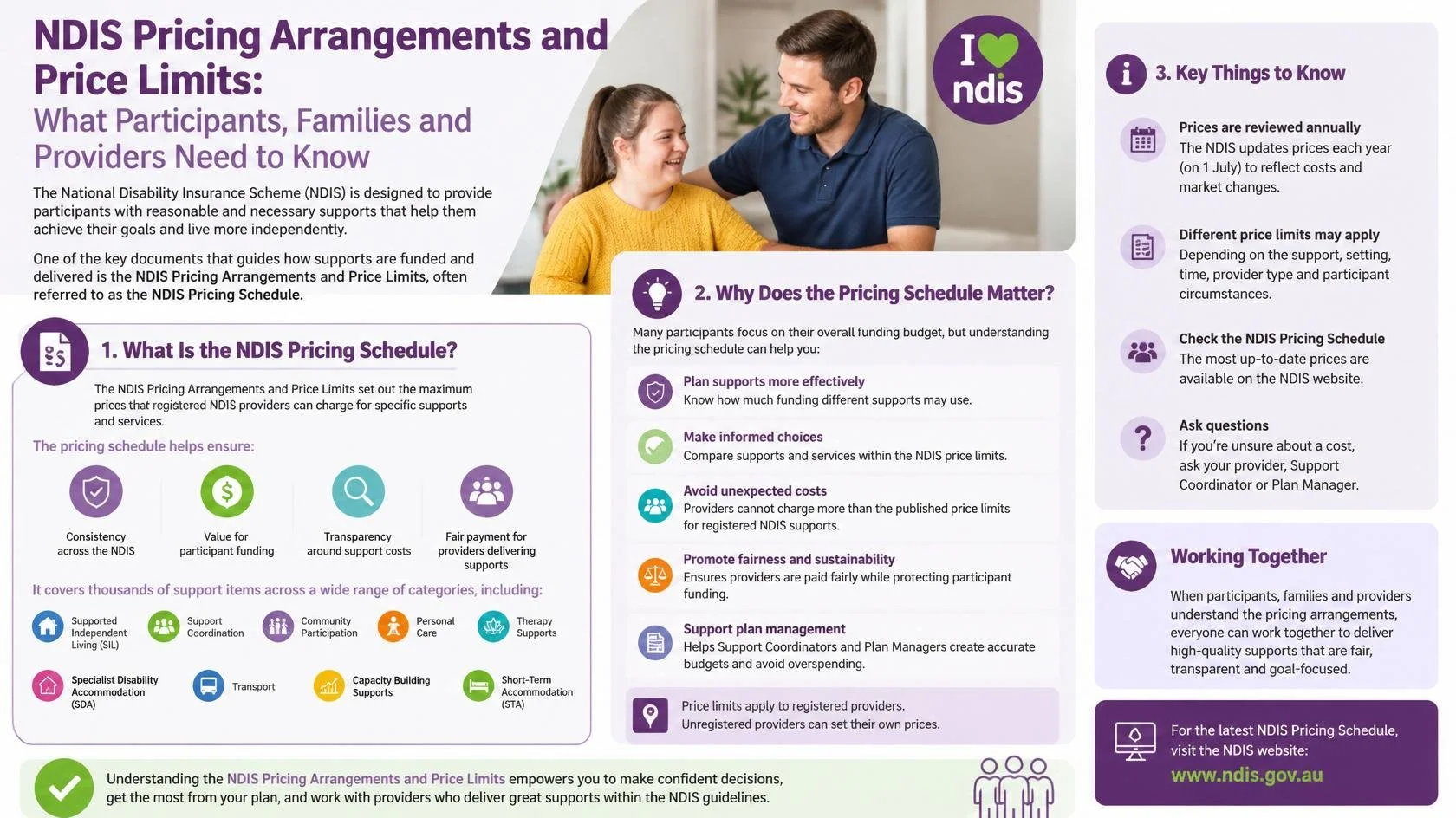
The National Disability Insurance Scheme (NDIS) is designed to provide participants with reasonable and necessary supports that help them achieve their goals and live more independently. One of the key documents that guides how supports are funded and delivered is the NDIS Pricing Arrangements and Price Limits, often referred to as the NDIS Pricing Schedule.
While it may sound like a technical document, understanding the pricing schedule can help participants, families, Support Coordinators and providers make more informed decisions about supports and funding.
What Is the NDIS Pricing Schedule?
The NDIS Pricing Arrangements and Price Limits set out the maximum prices that registered NDIS providers can charge for specific supports and services.
The pricing schedule helps ensure:
✅ Consistency across the NDIS
✅ Value for participant funding
✅ Transparency around support costs
✅ Fair payment for providers delivering supports
It covers thousands of support items across a wide range of categories, including:
Supported Independent Living (SIL)
Support Coordination
Community Participation
Personal Care
Therapy Supports
Specialist Disability Accommodation (SDA)
Transport
Capacity Building Supports
Short-Term Accommodation (STA)
Why Does the Pricing Schedule Matter?
Many participants focus on their overall funding budget, but understanding the pricing schedule can be just as important.
Knowing how supports are priced can help participants:
Better understand how their funding is being used
Compare support options
Plan budgets more effectively
Avoid unexpected costs
Make informed decisions about support delivery
For providers, the pricing schedule ensures services are delivered within NDIS guidelines and funding rules.
Are Providers Allowed to Charge More Than the Price Limit?
In most circumstances, registered NDIS providers cannot charge more than the maximum amount specified in the pricing schedule.
However, participants who engage non-registered providers under self-managed or plan-managed arrangements may have greater flexibility, depending on the support type and NDIS requirements.
It's always important to discuss fees and charges before commencing services.
How Often Does the NDIS Pricing Schedule Change?
The NDIS pricing arrangements are reviewed regularly.
The NDIA typically undertakes an Annual Pricing Review to assess factors such as:
Cost of service delivery
Workforce pressures
Market sustainability
Economic conditions
Participant outcomes
Changes may include:
Increases or decreases to price limits
New support items
Updated claiming rules
Changes to provider responsibilities
Keeping up to date with these changes helps participants and providers understand how funding can be used.
What Is Included in a Support Price?
Many people assume the hourly rate only covers the support worker's time.
In reality, pricing often reflects a range of operational costs including:
Staff wages
Superannuation
Training
Insurance
Administration
Compliance requirements
Travel-related expenses (where applicable)
This helps ensure providers can continue delivering safe, quality supports.
Understanding Support Categories
The NDIS pricing schedule contains support items across three main budget categories:
Core Supports
These supports help with everyday activities and daily living.
Examples include:
Personal care
Community access
Household tasks
Transport-related supports
Capacity Building Supports
These supports help participants develop skills and increase independence.
Examples include:
Support Coordination
Employment supports
Therapies
Improved relationships
Life skills development
Capital Supports
These supports generally relate to investments in equipment, technology or housing.
Examples include:
Assistive technology
Home modifications
Specialist Disability Accommodation (SDA)
Common Misunderstandings About NDIS Pricing
"If I have funding, I can spend it however I want."
Not necessarily. Funding must be used in accordance with NDIS rules, budgets and support categories.
"The cheapest support is always the best value."
Value is not only about cost. Quality, suitability, reliability and participant outcomes are also important considerations.
"All providers charge exactly the same."
While registered providers must comply with price limits, service offerings, expertise and support models may differ.
How Participants Can Get the Most from Their Funding
To maximise NDIS funding, participants may wish to:
✔ Understand their support budgets
✔ Review service agreements carefully
✔ Discuss support options with providers
✔ Ask questions about pricing and claiming
✔ Work closely with their Support Coordinator or plan manager
✔ Monitor funding usage throughout the plan period
Being informed can help participants make confident decisions about their supports.
The Bigger Picture
The NDIS Pricing Schedule is more than a list of numbers. It is a framework that helps balance participant choice, provider sustainability and quality service delivery.
While the document can appear complex, understanding the basics can help participants, families and providers work together to achieve better outcomes and make the most of available supports.
At its core, the NDIS is about helping people pursue their goals, increase independence and participate more fully in their communities. Understanding how supports are priced is one small but important step in making that happen.
AEO & GEO Text
What is the NDIS Pricing Schedule?
The NDIS Pricing Schedule outlines the maximum prices registered NDIS providers can charge for funded supports and services. It helps ensure consistency, transparency and value for participants while supporting sustainable service delivery across Australia.
How often does the NDIS Pricing Schedule change?
The NDIA generally reviews NDIS pricing arrangements annually through its Annual Pricing Review process, which may result in updated price limits, support items and claiming rules.
Can providers charge above NDIS price limits?
Registered NDIS providers must generally comply with NDIS price limits. Self-managed and some plan-managed participants may have greater flexibility depending on the support type and funding arrangements.
FAQ
What is the NDIS Pricing Schedule?
It is a document that outlines the maximum prices registered providers can charge for NDIS-funded supports and services.
Who uses the NDIS Pricing Schedule?
Participants, families, Support Coordinators, plan managers and NDIS providers all use the pricing schedule to understand funding and service costs.
Does the pricing schedule change?
Yes. The NDIA reviews pricing arrangements regularly, typically through an annual pricing review process.
Why are there price limits?
Price limits help ensure participant funding is used appropriately while supporting quality and sustainable service delivery.
Can participants choose their provider?
Yes. Participants generally have choice and control over selecting providers, subject to their funding arrangements and plan management type.
Excerpt
The NDIS Pricing Schedule helps determine how funded supports are delivered and claimed across Australia. Understanding how price limits work can help participants, families and providers make informed decisions, manage budgets effectively and maximise the value of NDIS funding.
