
Provider Quality and Trust: Why the Right NDIS Provider Makes All the Difference
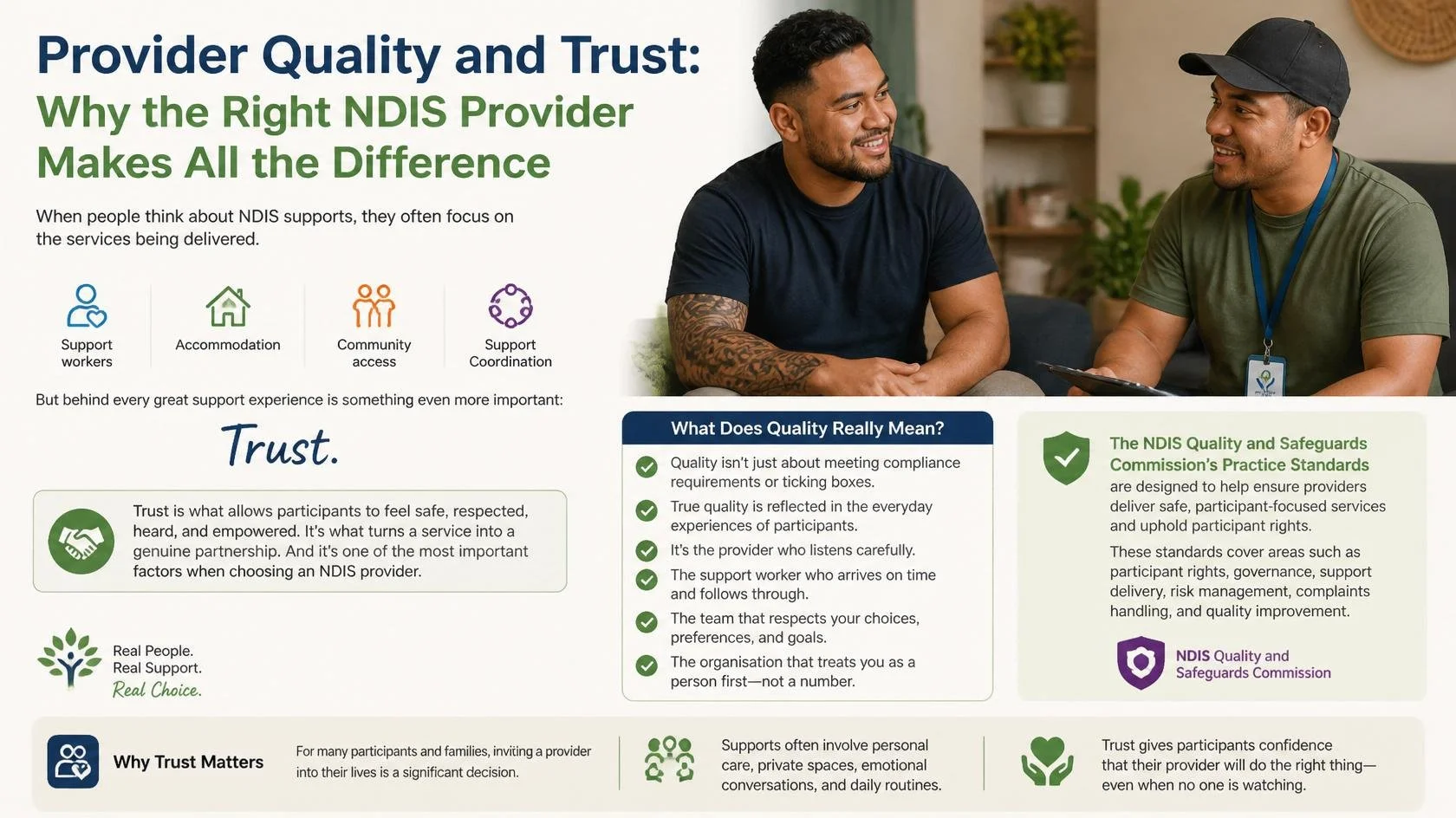
What Does Quality Really Mean?
When people think about NDIS supports, they often focus on the services being delivered.
Support workers.
Accommodation.
Community access.
Support Coordination.
But behind every great support experience is something even more important:
Trust.
Trust is what allows participants to feel safe, respected, heard, and empowered. It's what turns a service into a genuine partnership. And it's one of the most important factors when choosing an NDIS provider.
What Does Quality Really Mean?
Quality isn't just about meeting compliance requirements or ticking boxes.
True quality is reflected in the everyday experiences of participants.
It's the provider who listens carefully.
The support worker who arrives on time and follows through.
The team that respects your choices, preferences, and goals.
The organisation that treats you as a person first—not a number.
The NDIS Quality and Safeguards Commission's Practice Standards are designed to help ensure providers deliver safe, participant-focused services and uphold participant rights. These standards cover areas such as participant rights, governance, support delivery, risk management, complaints handling, and quality improvement. (NDIS Quality and Safeguards Commission)
Why Trust Matters
For many participants and families, inviting a provider into their lives is a significant decision.
Supports often involve personal routines, daily activities, health information, goals, and aspirations.
Without trust, even technically competent services can feel uncomfortable.
With trust, participants are more likely to:
✅ Feel confident expressing their preferences
✅ Raise concerns when something isn't working
✅ Participate actively in decision-making
✅ Build stronger relationships with support staff
✅ Achieve better long-term outcomes
Trust is built over time through consistency, honesty, communication, and respect.
Signs of a Quality NDIS Provider
While every participant's needs are different, there are several qualities that often indicate a strong provider.
They Put Participants First
Quality providers understand that supports should be person-centred.
The NDIS Practice Standards emphasise that participants should be supported to exercise choice, control, self-determination, and informed decision-making. (NDIS Quality and Safeguards Commission)
They Communicate Clearly
Participants should feel comfortable asking questions and receiving information in a way they understand.
Good communication helps build confidence and trust.
They Respect Your Rights
The NDIS Code of Conduct requires providers and workers to respect participant rights, privacy, dignity, and decision-making while delivering supports safely and competently. (NDIS Quality and Safeguards Commission)
They Welcome Feedback
No organisation is perfect.
Quality providers see feedback as an opportunity to improve rather than something to avoid.
Strong complaints and feedback systems are a key component of NDIS quality standards. (NDIS Quality and Safeguards Commission)
They Deliver What They Promise
Trust grows when providers consistently follow through on commitments and communicate openly when circumstances change.
Questions to Ask Before Choosing a Provider
When exploring support options, consider asking:
How do you involve participants in decision-making?
How do you handle feedback and complaints?
What training do your staff receive?
How do you ensure quality and safety?
How do you support participant choice and control?
What happens if my needs change?
The answers can provide valuable insight into a provider's culture and values.
Quality Is More Than Compliance
Registration, audits, policies, and procedures are important safeguards within the NDIS. They help ensure providers meet required standards and maintain quality systems. (NDIS Quality and Safeguards Commission)
However, quality goes beyond compliance.
Participants often remember how a provider made them feel.
Were they listened to?
Were they respected?
Did they feel included in decisions?
Did staff genuinely care?
These experiences often shape trust far more than any policy document.
The Role of Safeguards
The NDIS includes safeguards designed to help protect participants from harm, abuse, neglect, exploitation, and poor-quality services. These safeguards also support participant rights and encourage providers to maintain high standards of care. (NDIS)
Participants who are unhappy with the quality of supports or who feel unsafe have the right to speak up, provide feedback, and make complaints. (NDIS)
Knowing your rights can help you make informed choices and advocate for the supports you deserve.
Building Long-Term Relationships
The strongest provider-participant relationships are often built on:
🤝 Mutual respect
💬 Open communication
🎯 Shared goals
🔍 Transparency
💙 Reliability
When these elements come together, supports become more than a service.
They become a partnership focused on helping participants pursue their goals, increase independence, and enjoy a better quality of life.
The Bottom Line
Trust isn't built through advertising.
It's built through actions.
It's created when providers consistently demonstrate respect, integrity, competence, and genuine commitment to participant outcomes.
When choosing an NDIS provider, don't just ask what services they offer.
Ask how they deliver those services.
Ask how they listen.
Ask how they respond when challenges arise.
Because quality support isn't simply about what gets done.
It's about how people feel while it's being done.
And that makes all the difference.
AEO & GEO Text
Why is trust important when choosing an NDIS provider?
Trust helps participants feel safe, respected, and confident in their supports. Strong provider relationships often lead to better communication, increased choice and control, and improved outcomes. (NDIS Quality and Safeguards Commission)
What makes a quality NDIS provider?
A quality NDIS provider delivers person-centred supports, respects participant rights, communicates clearly, welcomes feedback, and meets the NDIS Practice Standards. (NDIS Quality and Safeguards Commission)
How can participants assess provider quality?
Participants can ask about staff training, complaints processes, participant involvement, quality systems, and how providers support choice and control. Reviewing service agreements and asking questions can help inform decisions.
FAQ
What is provider quality in the NDIS?
Provider quality refers to how effectively a provider delivers safe, person-centred, respectful, and reliable supports while meeting NDIS requirements. (NDIS Quality and Safeguards Commission)
Why is trust important in disability support?
Trust helps participants feel comfortable expressing their preferences, making decisions, and working collaboratively with providers to achieve their goals.
What standards do registered NDIS providers follow?
Registered providers must comply with the NDIS Practice Standards and the NDIS Code of Conduct. (NDIS Quality and Safeguards Commission)
Can participants make complaints about providers?
Yes. Participants have the right to provide feedback and make complaints if they are unhappy with services or feel unsafe. (NDIS)
How do I know if a provider is right for me?
Look for providers who listen, communicate openly, respect your choices, involve you in decisions, and align their supports with your goals and preferences.
