
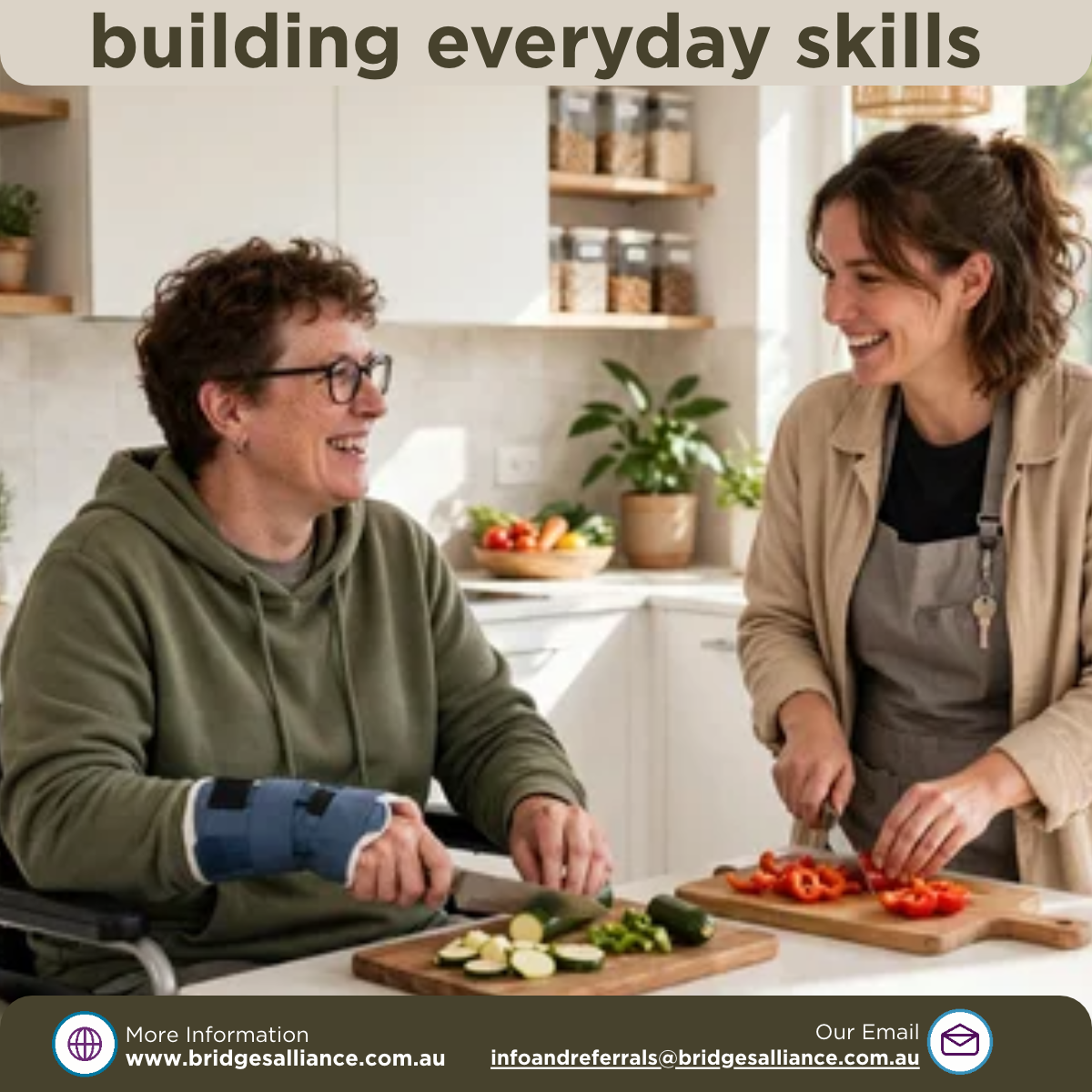
Alt text: Illustration of a bright shared kitchen in a supported living home, with residents cooking together at an accessible bench — building independence at home with Bridges Alliance
A comfortable home provides more than somewhere to sleep.
It can provide opportunities to develop everyday living skills, build relationships, participate in household activities and make independent choices.
At Bridges Alliance, we believe support should recognise individual strengths, preferences and aspirations.
Our supported accommodation services focus on creating opportunities for participants to live with greater confidence and involvement in everyday life.
What independence can look like at home
Independence does not look the same for everyone. For one person it may mean preparing a meal with less prompting. For another, it may mean choosing what to cook, managing a morning routine, or inviting a housemate to share an activity. Progress is personal, and it builds in everyday moments:
Everyday living skills — cooking and meal preparation, cleaning, laundry, shopping and budgeting, practised step by step.
Household participation — contributing to shared tasks, caring for shared spaces and being part of how the home runs.
Relationships — building friendships with housemates, sharing meals and activities, and staying connected to family and community.
Independent choices — deciding daily routines, activities, meals and goals, with support to understand options and consequences.
Confidence — trying new tasks, learning from what does not work first time, and recognising strengths and achievements.
The home itself matters. A bright kitchen where people can cook together and a welcoming shared living area where people can relax, talk and spend time together make participation easier and more enjoyable — which is why the suggested image for this post is a bright kitchen or a welcoming shared living area.
How support should work
Good support does with a person, not simply for them. That means starting from the participant’s strengths, preferences and aspirations, agreeing goals together, and adjusting support as confidence grows — stepping in where support is needed, and stepping back where a person can do more on their own.
On its website, Bridges Alliance describes putting participants first, with choice, flexibility and transparency in every service, matching participants with support workers who align with their preferences, and providing clear communication and regular feedback so support evolves with their needs. That approach is what turns accommodation into an opportunity to develop independence.
What Support Coordinators need to consider
When exploring supported accommodation for a participant, helpful questions to work through with the participant and their family include:
What are the participant’s strengths, preferences and aspirations, and what does independence mean to them?
Which everyday skills would they like to build, and what support helps them learn best?
What level of support is needed, day and night, and which routines, health or communication needs matter most?
Who would they like to live with, and what makes a home feel safe, comfortable and welcoming to them?
How will choice be supported day to day — in meals, activities, routines and household decisions?
What cultural, language or communication preferences should the team be aware of?
Bringing those details to an early conversation helps match a participant to a home and support team that genuinely fit, rather than simply filling a vacancy.
What Bridges Alliance offers
Bridges Alliance is an NDIS-registered disability support provider in NSW, specialising in supported accommodation, respite care, and independent living services across South West Sydney and surrounding regions.
Its services include Supported Independent Living (SIL), respite and Short-Term Accommodation, and long and medium term accommodation, with homes listed across South West Sydney and surrounding regions, including Glen Alpine, Mount Annan, Raby, Campbelltown, Leumeah and Grasmere.
Across our services, we provide high-quality, well-maintained accommodation that exceeds NDIS standards, with 90+ dedicated staff across 12+ high-quality accommodation and respite sites. For over seven years, Bridges Alliance has been building lifelong relationships rooted in consistency, compassion, and expertise, with a team speaking 30+ languages.
A note on SIL funding
Supported Independent Living (SIL) funding pays for the people who support a participant at home — person-to-person assistance with daily tasks, personal care, meal preparation and overnight support where approved. It does not pay rent, mortgage costs or everyday living expenses such as groceries and utilities, which are accounted for separately. Where a specially designed home is needed, the building itself is funded separately under Specialist Disability Accommodation (SDA).
SIL is generally intended for participants with higher support needs, and eligibility depends on the individual’s circumstances and evidence. Confirm what is included in the participant’s current NDIS plan before making arrangements.
How to start the conversation
Support Coordinators are welcome to contact our team to discuss accommodation and support options.
Step 1: Clarify goals — what independence, skills and living arrangements the participant wants.
Step 2: Contact Bridges Alliance — call 02 8188 4317 or email infoandreferrals@bridgesalliance.com.au.
Step 3: Discuss needs — we will work with you to understand strengths, preferences, support requirements and aspirations.
Step 4: Explore the home — consider the home, housemates and supports together, and whether they may be suitable.
Google button: Add a Squarespace button block at the end of the post (and, if using Google Business Profile, as the post button) with the text “Learn more”, linked to https://www.bridgesalliance.com.au/contact
Bridges Alliance – Your journey, our commitment.
Contact — Bridges Alliance Pty Ltd: Phone: 02 8188 4317 • Email: infoandreferrals@bridgesalliance.com.au • Suite 2/178 Queen St, Campbelltown NSW 2560 • www.bridgesalliance.com.au

Alt text: Illustration of a welcoming shared living area in a supported living home, with residents playing a board game, reading and talking together
Frequently asked questions (FAQ)
Paste this FAQ at the end of the blog post, after “How to start the conversation” and before the contact box. The same wording is used in the FAQ schema below — keep them identical so search and AI answers match the page.
What is Supported Independent Living (SIL) and supported accommodation?
Supported Independent Living (SIL) is an NDIS-funded support that helps participants with higher support needs live as independently as possible at home. SIL pays for support workers who assist with daily tasks, personal care, meal preparation and overnight support where approved. Supported accommodation is the home in which that support is provided. Bridges Alliance provides SIL and supported accommodation across South West Sydney and surrounding regions.
How does a supported home help a participant develop independence?
A supported home helps a participant develop independence by providing everyday opportunities to practise living skills, participate in household activities, build relationships and make independent choices, with support shaped to their strengths, preferences and aspirations. At Bridges Alliance, support focuses on doing tasks with a participant, not simply for them, so confidence and involvement in everyday life can grow over time.
Who is Bridges Alliance supported accommodation suitable for?
Bridges Alliance supported accommodation is for people living with disability who need support to live at home, including participants with SIL funding in their NDIS plan. Suitability depends on the participant’s support requirements, preferences, goals and compatibility with the home and housemates. Support Coordinators are welcome to contact Bridges Alliance on 02 8188 4317 to discuss whether an option may be suitable.
What everyday skills and activities can participants practise at home?
Participants can practise cooking and meal preparation, cleaning, laundry, shopping, budgeting, personal routines and caring for shared spaces. They can also participate in household decisions, shared meals and activities, and build relationships with housemates. The skills a participant works on are agreed with them, based on their own goals and aspirations.
What does SIL funding cover, and what does it not cover?
SIL funding covers person-to-person support at home, such as assistance with daily tasks, personal care, meal preparation, medication support and overnight assistance where approved. It does not cover rent, mortgage costs or everyday living expenses such as groceries and utilities. A specially designed building, where needed, is funded separately under Specialist Disability Accommodation (SDA). Confirm what is included in the participant’s current NDIS plan before making arrangements.
How do Support Coordinators discuss options or refer a participant?
Call Bridges Alliance on 02 8188 4317 or email infoandreferrals@bridgesalliance.com.au. Share the participant’s strengths, preferences, aspirations, support requirements, routines and any accessibility, cultural or communication needs. The team will discuss accommodation and support options and whether they may be suitable.
AEO & GEO text
1
What is Supported Independent Living (SIL) under the NDIS?
Support at home for higher support needs; builds independence
2
Who provides Supported Independent Living in South West Sydney?
Bridges Alliance named
3
How can a supported home help a participant develop independence?
Living skills, household activities, relationships, choices
4
What everyday skills can NDIS participants practise in supported accommodation?
Cooking, cleaning, laundry, shopping, budgeting, routines
5
What should a Support Coordinator consider when choosing supported accommodation?
Strengths, preferences, aspirations, support needs, fit
6
What does SIL funding cover and not cover?
Covers support people; not rent or everyday living costs
7
Who is Bridges Alliance?
NDIS-registered NSW provider; SIL, respite, accommodation; Campbelltown
8
How do I enquire about Bridges Alliance supported accommodation?
02 8188 4317; infoandreferrals@bridgesalliance.com.au
9
What makes a good SIL home more than just accommodation?
Opportunities to build skills, confidence and involvement
10
Does Bridges Alliance support participants to make independent choices?
Yes — choice, strengths, preferences and aspirations
