How Employment Outcomes Help Participants Make Informed Choices
Bridges Alliance | NDIS News & Updates | October 2026
Finding meaningful employment can be an important step towards greater independence, confidence, financial participation and connection with the community. For people with disability, the right employment support can help turn career goals into practical opportunities.
The National Disability Insurance Agency (NDIA) publishes employment provider reports to help people understand the outcomes achieved by providers delivering NDIS-funded employment assistance. These reports also support transparency by showing how employment providers help participants develop work skills, explore opportunities and work towards employment goals.
For participants, families, nominees and support coordinators, understanding how to use these reports can make conversations about employment support more informed and productive.
At Bridges Alliance, we believe every person should be supported to pursue their individual goals, build on their strengths and exercise choice and control over the direction of their life.
What are NDIS employment provider reports?
NDIS employment provider reports contain information submitted by employment providers about the assistance they deliver and the employment outcomes participants achieve.
The NDIA uses information from provider quarterly reports to monitor and evaluate employment assistance. Published reports provide insights into the support participants receive, their progress towards employment milestones and the outcomes recorded at the end of a service.
The information can help participants understand what different providers offer and prepare questions when deciding which provider may best suit their needs.
Published outcomes are one source of information, rather than a guarantee of future results. Every participant has different skills, preferences, circumstances and employment goals.
The reports should therefore be considered alongside discussions about service quality, individualised support, workplace opportunities and the participant's own priorities.
You can access the official information on the NDIS Employment Provider Reports page.
Why does employment outcome reporting matter?
Transparent reporting can help participants and their support networks understand how employment assistance is being delivered and what outcomes providers report.
It also encourages a more informed conversation about the relationship between the support provided and progress towards employment.
Employment outcomes may include progress with work-related skills, gaining work experience, moving into paid employment or receiving assistance to maintain or progress an existing job.
Reporting is particularly useful when participants are comparing providers. Rather than relying on general promotional claims, participants can use published information to ask specific questions about the services offered and how support is tailored to individual circumstances.
For providers, accurate reporting helps the NDIA evaluate employment assistance and identify approaches that may contribute to positive employment outcomes.
However, outcomes should always be interpreted in context. A reported result does not necessarily explain every factor influencing a participant's experience, and past outcomes cannot guarantee an individual's future employment success.
Which NDIS participants are included in employment provider reporting?
From 1 January 2026, the NDIA's employment provider reporting requirements cover specified groups of participants receiving employment-related assistance.
These include:
Young people still at school: Participants aged 14 and over receiving supplementary work experience to complement their school curriculum or assistance to find and maintain a part-time job outside school hours.
School leavers: Participants receiving intensive assistance to develop work skills and transition from school to employment.
People transitioning to further education or training: Participants moving into tertiary education, traineeships or apprenticeships, or receiving assistance to obtain employment relevant to their qualifications.
Adults with limited work history: Participants aged 20 and over with minimal work experience or work history who are receiving assistance to obtain open employment.
People already in open employment: Participants of any age receiving assistance to change jobs, progress their careers, stabilise their employment or maintain their existing work.
These reporting categories help the NDIA understand how employment assistance is being used across different stages of a person's working life.
The requirements apply to providers delivering relevant employment assistance. They do not mean that every NDIS participant must be seeking paid work or that every participant will be included in these reports.
Employment goals should reflect the individual's circumstances, preferences and aspirations.
What information do employment providers report?
Employment providers must submit information about the assistance they deliver and the progress participants make during the reporting period.
The reporting tool includes information such as:
Participant details and employment circumstances.
The participant's status and goals at the beginning of the service.
Supports delivered and progress towards employment milestones.
Whether the participant is expected to continue receiving support in the following quarter.
The final outcome when the participant finishes the service.
Relevant employment details once the participant is employed.
Providers are also required to validate their information before submitting a report.
Accurate reporting is important because the information contributes to the NDIA's monitoring of employment assistance and the outcomes presented in published reports.
For participants, this highlights the value of having clear conversations with their employment provider about goals, the assistance being delivered and how progress is being reviewed.
How often must employment providers submit reports?
Employment providers covered by the reporting requirements must submit their reports quarterly using the NDIA's employment provider reporting tool.
The standard reporting timetable is:
Reporting periodDue date1 January – 31 March7 April1 April – 30 June7 July1 July – 30 September7 October1 October – 31 December7 January
When a due date falls on a weekend or public holiday, the report is due on the following business day.
Providers should use the latest reporting tool and instructions published by the NDIA, complete the required validation steps and follow the specified submission process.
For current instructions and downloadable resources, visit How to Report on Employment Outcomes.
How can participants use the published reports when choosing an employment provider?
Choosing an employment provider is a personal decision. Published outcomes can help participants prepare for that decision, but they should form only one part of the process.
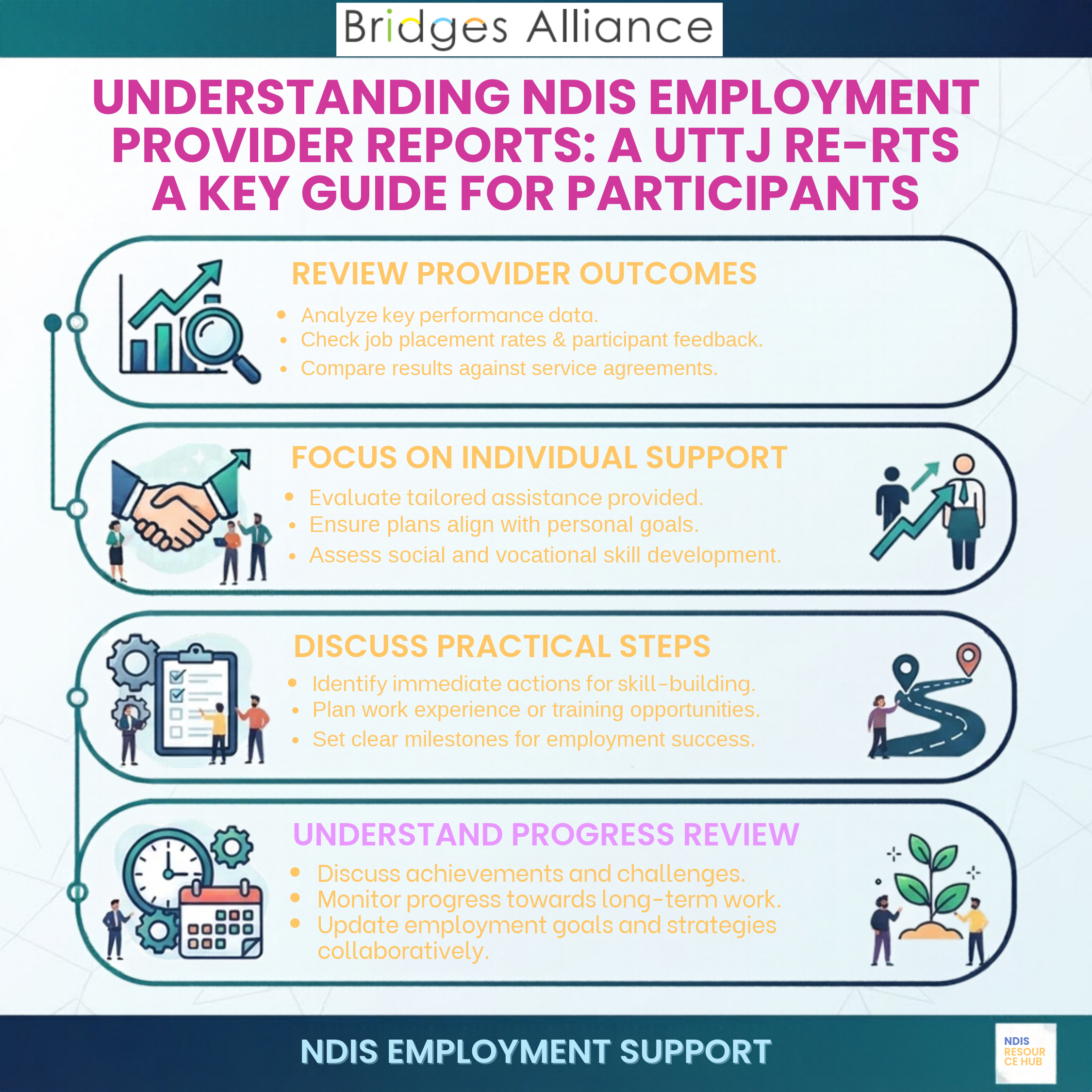
Here are five practical steps to consider.
1. Explore the outcomes reported by providers
Review the available reports and look for information relevant to your circumstances, such as the type of participants supported and the outcomes recorded.
Remember that reported results reflect past experiences and are not a prediction of what will happen for an individual.
2. Ask about individualised support
Ask how the provider will understand your strengths, interests, skills, support needs and employment goals.
A suitable service should take the time to understand what matters to you rather than offering the same approach to everyone.
3. Discuss the practical steps towards employment
Ask how support may help you develop work-related skills, prepare for interviews, gain experience, communicate with employers or explore appropriate workplace adjustments.
The type of support available will depend on your goals, eligibility, funding and the provider's service arrangements.
4. Understand how progress will be reviewed
Ask how you will work with the provider to set goals, review progress and discuss any barriers that arise.
You should have opportunities to express your views and help shape the support you receive.
5. Consider the overall service, not just one result
Think about the provider's communication, experience, approach to individualised support, accessibility and ability to work towards your goals.
You may also wish to ask how the provider works with employers, education providers and other employment services where appropriate.
The aim is to make an informed choice based on your own circumstances—not simply to select a provider with the highest reported outcome.
What employment support can help people work towards
NDIS employment assistance can support participants to build skills, explore employment options and work towards suitable opportunities.
Depending on the participant's goals and funded supports, assistance may include:
Exploring career interests, strengths and transferable skills.
Developing workplace communication and social skills.
Preparing for job applications and interviews.
Building practical skills through appropriate work experience.
Engaging with employers and exploring job customisation.
Identifying workplace barriers and discussing possible adjustments.
Developing strategies to maintain employment or progress a career.
Building confidence with workplace routines and expectations.
The NDIA's employment guidance highlights progress in areas such as employer engagement, job customisation, learning job skills, gaining work experience and improving communication and social skills as factors associated with a greater likelihood of obtaining paid employment.
These are reported associations, not guarantees. The right combination of support will depend on the individual, the work environment and the opportunities available.
Read the NDIA's Guide to Providing Employment Supports for more information.
Understanding the relationship between NDIS supports and mainstream employment services
NDIS employment assistance is not the only source of help available to people with disability who want to work.
Depending on individual circumstances, mainstream employment services, education providers, training organisations and employers may also provide relevant assistance.
For example, Inclusive Employment Australia provides employment assistance to eligible people with disability who need help finding and keeping a job, and can support employers to develop more inclusive workplaces.
Where a participant uses both NDIS-funded employment supports and mainstream employment services, the services should work together appropriately to help clarify responsibilities and reduce gaps or unnecessary duplication.
The NDIA's guidance encourages employment providers to work with relevant mainstream services where appropriate and to develop a joint plan that explains each provider's role.
Participants should seek clarification about which supports are available through their NDIS plan and which may be accessed through other programs.
How Bridges Alliance supports individual goals and community participation
At Bridges Alliance, we recognise that independence and meaningful participation look different for every person.
Our disability support services aim to help participants develop everyday skills, pursue personal interests, build confidence and participate in their communities in ways that reflect their preferences and goals.
Depending on individual needs, eligibility and agreed service arrangements, our supports include Supported Independent Living (SIL), Support Coordination, personal care, assistance with daily living and community participation.
These supports are not a substitute for specialised employment services. However, they may complement a participant's broader goals by helping them develop routines, practise daily living skills, access community activities and work towards greater independence.
For example, a participant may want to develop confidence using public transport, improve everyday communication, practise managing routines or participate in activities that reflect their interests. Where these goals align with the participant's plan and agreed supports, assistance may help build skills that are relevant to wider participation in life, including future employment aspirations.
Any support provided should remain within the agreed service scope and applicable NDIS requirements.
We encourage participants, families and nominees to discuss their goals with the relevant members of their support network and seek specialised employment assistance where appropriate.
Where can you find official NDIS employment reporting information?
The NDIA provides several useful resources for participants and providers.
Employment Provider Reports
View published quarterly reports, provider outcome information and resources for comparing employment assistance providers.
How to Report on Employment Outcomes
Read about reporting responsibilities, reporting periods, required information and submission procedures.
Guide to Providing Employment Supports
Learn about employment support planning, workplace assistance, employment outcomes and working with mainstream employment services.
These official resources should be checked for the latest reporting tools, requirements and published results.
Moving towards meaningful employment and informed choice
NDIS employment provider reports are a useful resource for understanding how employment assistance is delivered and the outcomes providers report.
For participants, the reports can support better questions, more informed conversations and a clearer understanding of available services. For providers, accurate reporting helps the NDIA evaluate employment assistance and understand progress towards employment goals.
Ultimately, meaningful employment support should be about more than a reported statistic. It should recognise the individual, respect their choices and help them work towards goals that matter to them.
At Bridges Alliance, we believe every person deserves the opportunity to build skills, develop confidence and participate in their community in a way that reflects their aspirations.
Bridges Alliance — Building Bridges. Empowering Lives.
Visit Bridges Alliance to learn more about our disability support services in NSW.
Disclaimer: This article provides general information only and is not employment, legal or individual NDIS funding advice. Employment provider reporting requirements, published results and service eligibility may change. Always consult the current official NDIA guidance and relevant service providers for advice specific to your circumstances.
Frequently asked questions
1. What are NDIS employment provider reports?
They are reports based on information submitted by employment providers about the assistance delivered to participants, progress towards employment milestones and reported employment outcomes.
2. Why does the NDIA publish employment provider outcomes?
The information helps the NDIA monitor and evaluate employment assistance. Published provider outcomes can also help participants understand provider performance and compare available services when making informed decisions.
3. Which participants are included in employment provider reporting?
The requirements cover specified groups, including eligible school students aged 14 and over, school leavers, participants transitioning to further education or training, adults aged 20 and over with minimal work history seeking open employment, and people receiving assistance to change jobs or maintain or progress their careers.
4. How often must employment providers submit reports?
Providers covered by the requirements submit quarterly reports, ordinarily due on 7 April, 7 July, 7 October and 7 January. Weekend and public holiday adjustments apply.
5. What information do providers include in their reports?
Reports include participant details, initial employment status and goals, support delivered, progress towards milestones, whether support will continue, final service outcomes and relevant employment details.
6. Can I use employment provider reports to choose a provider?
Yes. Published outcomes can help you prepare questions and compare information about providers. Consider the reported results alongside your individual goals, the provider's approach, service suitability and the support available to you.
7. Do published employment outcomes guarantee I will get a job?
No. Published outcomes describe results reported for previous participants. Your own outcome will depend on your circumstances, goals, support needs, opportunities and other relevant factors.
8. Can NDIS supports help me prepare for employment?
Depending on your plan and circumstances, NDIS-funded employment assistance may help you build work skills, prepare for employment, gain experience or receive appropriate support in the workplace. Other disability and mainstream employment services may also be relevant.
9. Where can I find the latest employment provider reports?
Visit the NDIA's Employment Provider Reports page for published reports, provider outcomes and related resources.
10. Does Bridges Alliance provide specialised employment services?
Bridges Alliance provides disability support services including Support Coordination, SIL, personal care and community participation, subject to individual arrangements. Contact our team to discuss our service scope and whether our supports may complement your broader goals.
