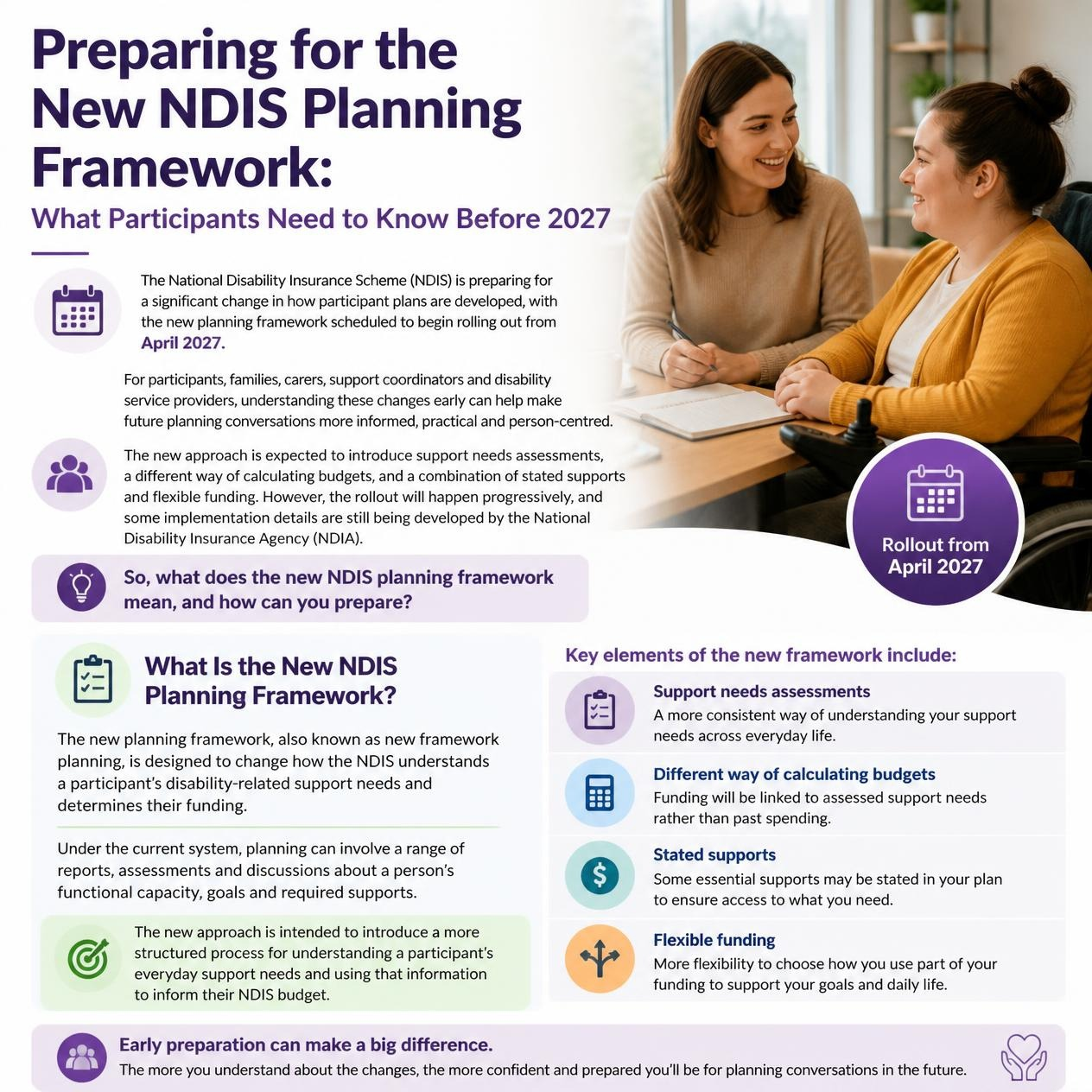
The National Disability Insurance Scheme (NDIS) is preparing for a significant change in how participant plans are developed, with the new planning framework scheduled to begin rolling out from April 2027.
For participants, families, carers, support coordinators and disability service providers, understanding these changes early can help make future planning conversations more informed, practical and person-centred.
The new approach is expected to introduce support needs assessments, a different way of calculating budgets, and a combination of stated supports and flexible funding. However, the rollout will happen progressively, and some implementation details are still being developed by the National Disability Insurance Agency (NDIA).
So, what does the new NDIS planning framework mean, and how can you prepare?
What Is the New NDIS Planning Framework?
The new planning framework, also known as new framework planning, is designed to change how the NDIS understands a participant’s disability-related support needs and determines their funding.
Under the current system, planning can involve a range of reports, assessments and discussions about a person’s functional capacity, goals and required supports.
The new approach is intended to introduce a more structured process for understanding a participant’s everyday support needs and using that information to inform their NDIS budget.
The NDIA has identified three important features of the new approach:
Support needs assessments conducted through guided conversations with trained assessors.
A funding approach informed by information collected about a participant’s support needs.
A combination of stated supports and a flexible budget.
The aim is to make planning more consistent while considering the individual circumstances of participants.
Importantly, April 2027 marks the planned start of the rollout, not a date when every participant will automatically move to the new system. Participants should continue following their current plan arrangements unless the NDIA advises them otherwise.
What Is an NDIS Support Needs Assessment?
A support needs assessment is a structured process intended to help the NDIA understand the type, amount and frequency of disability-related support a person needs in everyday life.
Rather than focusing solely on a diagnosis or a single functional assessment report, the process is intended to consider how a person’s disability affects their daily activities, participation and independence.
A trained assessor will guide the conversation through relevant areas of a person’s life. Depending on the final arrangements, information about personal and environmental circumstances will also help build a clearer picture of the participant’s needs.
What is I-CAN V6?
I-CAN V6 is a version of the Instrument for the Classification and Assessment of Support Needs, a tool developed to help describe a person’s support needs across different areas of everyday life.
The NDIA has discussed using I-CAN V6 alongside a personal and environmental circumstances questionnaire as part of the new planning approach.
The purpose is to collect structured information that can help inform planning decisions. It should not be understood as a standalone diagnosis or a guarantee of a particular funding outcome.
The final assessment process, including how information is considered and how participants can contribute additional evidence, should be checked against the latest NDIA guidance before an individual assessment.
How is this different from current functional assessments?
Functional assessments and professional reports can describe how a person’s disability affects activities such as mobility, communication, personal care, decision-making and daily living.
A support needs assessment is intended to take a broader, structured approach to understanding support requirements and informing a plan budget.
This does not automatically mean existing reports will become irrelevant. Professional evidence may still be important, particularly where a person has complex needs or requires specialist support.
The key preparation step is to build a clear picture of everyday life, including the supports that help a person remain safe, participate in the community and work towards their goals.
How Could NDIS Budgets Change?
Another important feature of the new planning framework is the proposed combination of stated supports and flexible budget funding.
1. Stated supports
Stated supports are funding allocated for a particular purpose or support. The funding must be used in accordance with the relevant restrictions.
This means it will be important to understand which supports are specifically stated in a plan and what conditions apply to that funding.
2. Flexible budgets
Flexible budgets are intended to give participants more flexibility to choose between eligible NDIS supports within the applicable funding rules.
This could provide greater scope to respond to changing priorities and make choices about how funded supports are delivered.
However, flexible funding does not mean that every purchase or service will automatically be permitted. Participants will still need to follow the rules governing eligible NDIS supports and the use of their plan funds.
The detailed rules for the new planning framework are still being developed. Participants and providers should therefore avoid making financial or service-delivery decisions based on assumptions about how future budgets will work.
Will NDIS Plans Last Longer?
The new planning framework is part of broader efforts to improve the planning process, including how often plans need to be reviewed.
Longer plan periods and fewer routine planning reviews have been discussed as part of the reform direction. However, participants should not assume that every plan will have the same duration or that reviews will no longer be required.
A participant’s circumstances, support needs and the applicable rules will continue to matter. Changes in circumstances may also require attention during a plan period.
For now, continue to monitor your existing plan dates and respond to any communication from the NDIA about reviews, reassessments or transition arrangements.
How to Prepare for a Future NDIS Planning Conversation
Although participants do not need to take immediate action simply because the framework is changing, preparing an accurate picture of everyday support needs can be useful at any stage of the NDIS journey.
1. Document everyday support needs
Think about the practical support required throughout a typical day and week.
Consider areas such as:
Personal care, dressing and hygiene.
Meal preparation and household tasks.
Communication, decision-making and daily routines.
Getting to appointments and participating in the community.
Managing changes in routine and unfamiliar environments.
Support required to maintain safety and independence.
Where appropriate, describe how frequently support is needed, how long tasks take, and what happens when assistance is unavailable.
2. Record what works and what does not
Make a note of the supports that help you achieve meaningful outcomes, as well as any gaps or difficulties.
For example, a participant may be able to attend a community activity when transport and appropriate support are available, but may be unable to participate consistently without them.
Practical examples can help explain the difference between what a person can do occasionally and what they can manage reliably in everyday life.
3. Review your goals
Goals should reflect what matters to the participant, not simply the services currently being received.
These might include developing independent living skills, maintaining relationships, accessing education or employment, participating in community activities, or making decisions with greater confidence.
Consider what progress has been made and what support may be needed to continue working towards those goals.
4. Organise relevant reports and records
Keep copies of relevant professional reports, support summaries, progress notes and other evidence that helps explain your needs.
Ask treating professionals or providers for clear, factual information where appropriate. Evidence should explain functional impacts and support requirements rather than simply list diagnoses or services.
Not every participant will need the same documents, and the NDIA will provide guidance about the evidence required under the new process.
5. Involve the right people
Participants should remain central to discussions about their lives and support needs.
Depending on the person’s preferences, this may involve family members, carers, support coordinators, trusted supporters or relevant professionals.
If communication, sensory needs, language or accessibility requirements affect participation in conversations, identify these needs and ask what adjustments can be arranged.
The goal is to help the participant express their priorities and circumstances as clearly and comfortably as possible.
What Should Support Coordinators and Providers Do Now?
Support coordinators and providers can help participants prepare by keeping records accurate, current and focused on individual outcomes.
Useful steps include reviewing support arrangements, documenting changes in needs, discussing goals with participants and ensuring reports describe the practical impact of disability-related support requirements.
Providers should avoid promising particular funding outcomes or advising participants to purchase services based on anticipated changes that have not been confirmed.
Instead, communicate what is known, explain what remains uncertain, and direct participants to official NDIA updates when questions concern future planning rules.
At Bridges Alliance, a person-centred approach means recognising that every participant has different strengths, preferences and support requirements. Preparing for planning changes should begin with listening to the person and understanding what helps them live the life they choose.
What Happens Next?
The new NDIS planning framework is expected to begin rolling out from April 2027, with participants transitioning over time.
Until the NDIA confirms arrangements for an individual participant, existing plans and applicable rules remain important.
The most useful preparation is not to predict a future funding outcome. It is to build a clear, practical understanding of the participant’s everyday support needs, current arrangements, goals and preferred outcomes.
By keeping information organised and staying informed through official updates, participants, families and providers can approach future planning conversations with greater confidence.
Need help preparing for your next NDIS planning conversation?
Bridges Alliance encourages participants, families and support networks to start by documenting everyday support needs and identifying the outcomes that matter most.
Contact Bridges Alliance to enquire about available planning information sessions, practical preparation resources or support options. Ask whether a planning workshop or checklist is currently available.
For official updates about the new planning framework, visit the NDIS website and check the latest information before making decisions about your plan.
Frequently asked questions (FAQ)
These questions are suitable for an FAQ section at the end of the blog. They also help address specific searches and conversational questions people may ask through Google or AI assistants.
When does the new NDIS planning framework start?
The new NDIS planning framework is scheduled to begin rolling out from April 2027. The transition will occur over time, so not every participant will move to the new system on the same date.
What is an NDIS support needs assessment?
It is a structured, guided conversation with a trained assessor intended to understand a participant’s everyday support needs and inform their NDIS funding.
What is I-CAN V6 in the NDIS?
I-CAN V6 is a structured support-needs assessment tool that the NDIA has discussed using alongside a questionnaire about a participant’s personal and environmental circumstances. The final assessment arrangements should be checked against current NDIA guidance.
Will my current NDIS plan change in April 2027?
Not necessarily. The new framework is expected to roll out progressively. Continue using your current plan under its existing rules unless the NDIA tells you that your arrangements are changin
What is the difference between stated supports and a flexible NDIS budget?
Stated supports must be used for the specified purpose or support. Flexible budget funding can generally be used across eligible NDIS supports, subject to the rules that apply to the plan.
Will NDIS participants need new assessments?
The new framework includes support needs assessments as part of its planning approach. Whether and when an individual participant needs an assessment will depend on transition arrangements and NDIA instructions.
How can I prepare for a new NDIS planning assessment?
Document everyday support needs, current services, goals, practical examples of functional impacts and any relevant professional reports. Ask the NDIA about the specific information required for your circumstances.
Will the new framework guarantee more flexible funding or longer plans?
No individual funding outcome or plan duration should be assumed. The framework is intended to introduce more flexible budgets and change the planning approach, but the applicable rules and individual circumstances will determine how plans work.
AEO and GEO text
Quick answer: What is changing in NDIS planning from 2027?
The new NDIS planning framework is scheduled to begin rolling out from April 2027. It is intended to introduce structured support needs assessments, budgets informed by assessment information, and a combination of stated supports and flexible funding. The rollout will be progressive, and some implementation rules are still being developed. Participants should continue following their existing plan arrangements until the NDIA confirms changes to their individual circumstances.
Bridges Alliance recommends preparing by documenting everyday support needs, reviewing goals, keeping relevant evidence organised and following official NDIS updates.
