NDIS Accommodation & Support Coordination Changes
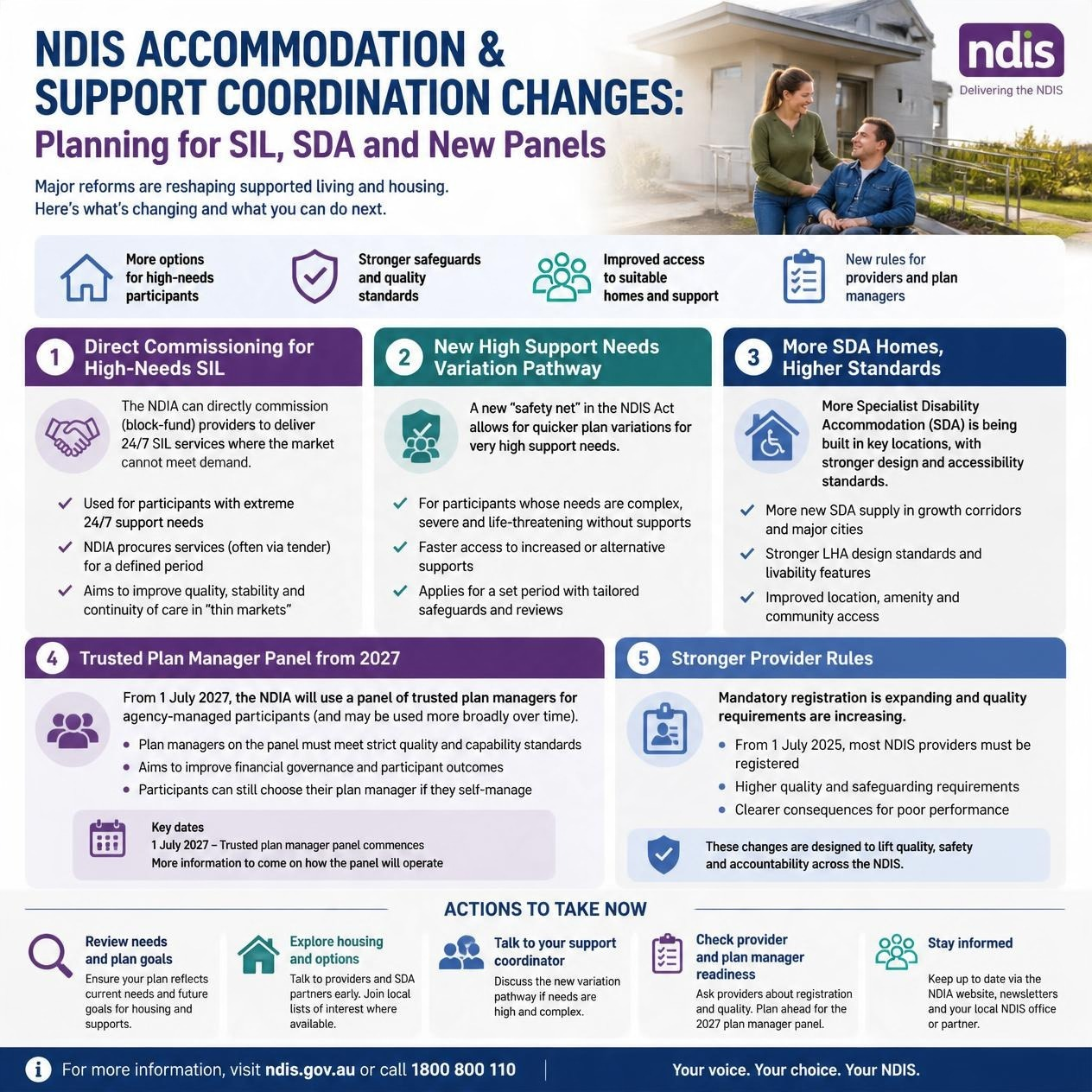
The NDIS is introducing major reforms to supported living and housing. High‐needs participants, providers and support coordinators need to know about new approaches to Supported Independent Living (SIL), Specialist Disability Accommodation (SDA) and provider panels. For example, the NDIA can now directly commission long-term SIL services for people with 24/7 support needs, and there’s a special plan variation “safety net” for very high‐support cases. Meanwhile, new SDA homes are being built in key cities and accessibility standards are rising. A trusted government panel of plan managers will be introduced from 2027, and mandatory registration of most providers is expanding. This guide explains what’s changing and suggests actions for families and providers to plan ahead.
Direct Commissioning for High-Needs SIL and New Variation Pathway
The NDIA has expanded its market management tools. One is direct commissioning, which means the NDIA can contract (or “block-fund”) providers to deliver services when the market can’t meet demand. In practice, this may be used for participants with extreme 24/7 supports. Under a direct commissioning arrangement, the NDIA specifies and procures services (often via a tender) for a defined period. The goal is to improve quality and stability of round-the-clock care in “thin markets” where few providers operate.
In tandem, the NDIS law now includes a high support needs variation pathway. If a participant’s approved plan funds ongoing 24/7 SIL or daily living supports but becomes insufficient to cover them, the NDIA must increase the budget accordingly. This applies to participants with very high annual budgets (currently at least ~$215,000 for continuous 24‑hour care). In practical terms, a participant (or their nominee) can request extra funding if sudden or complex needs arise that their current plan can’t meet. The NDIA then has up to 90 days to decide to reassess or vary the plan. This creates a safety net ensuring support won’t drop out mid-year. (See FAQs below for more on high-need variations.)
Specialist Disability Accommodation (SDA): Pipeline and Application
More SDA housing is coming, but demand is still high. The latest data show a growing pipeline of new SDA dwellings, especially in capital cities. Melbourne, Sydney, Brisbane and Perth have the most new SDA projects underway. However, supply is uneven – there are plenty of Improved Liveability and Fully Accessible homes (for those with mild to moderate needs), while High Physical Support SDA (for the most complex needs) remains scarce. In practice, this means many eligible participants still struggle to find an available SDA vacancy.
To apply for SDA funding, a participant must meet strict eligibility under the NDIS SDA rules – namely extreme functional impairment or very high support needs. A detailed assessment and evidence from occupational therapists or medical specialists is required. Applicants should gather thorough reports showing why an accessible, purpose-built home is “reasonable and necessary” for their disability. Scope Australia’s guide to applying for SDA is a useful reference (see [Scope Australia][31]).
Once approved for SDA funding, the next step is finding a dwelling. Participants and coordinators should actively register interest with SDA providers and search vacancy lists. The Summer Foundation Housing Hub is an excellent tool: it lets you filter by location, SDA design category, and type, and even set vacancy alerts. Keep in mind that waitlists for SDA are common. If a suitable home isn’t immediately available, ask your support coordinator about interim options (like accessible rental housing) while waiting for a build.
Accessibility standards are improving. All new SDA (and many new homes) must meet higher design criteria. The National Construction Code (NCC) has been moving toward mandatory accessibility features. For example, Queensland has already begun implementing the NCC 2022 “Modern Homes” (livable housing) standards via its building code. South Australia plans to formally adopt the NCC 2022 livable provisions by October 2024. This means future housing (including SDA projects) will increasingly include step-free entries, wider doorways, reinforced walls for hoists, and other supports. Providers planning new builds should follow these updates; participants should watch for SDA projects billed as meeting “NCC 2022” or liveable housing standards.
Plan Management Panel and Provider Registration Changes
Plan Management Panel (Oct 2027): From 1 October 2027, participants who choose a plan manager will have to pick from a pre-approved panel of providers. The NDIA will announce the panel in mid-2027 and participants will have 6 months to transition (so by April 2028 all plans use panel managers). The government’s goal is to ensure plan managers meet uniform quality and compliance standards. Families should discuss this with their planners or current plan managers well in advance. Ask prospective plan managers whether they intend to join the panel, and get planning meetings on the calendar before late 2027.
Expanded Mandatory Registration (2026–27): The NDIS Quality and Safeguards Commission is tightening oversight of high-risk supports. All Supported Independent Living (SIL) providers must be registered by the Commission. In fact, from 1 July 2026 any new provider of SIL needs to be registered, and existing unregistered SIL providers had to apply by 1 October 2026 or cease services. This ensures minimum standards in 24/7 housing.
Moreover, the 2026–27 Budget funds a major expansion: from 1 July 2027, mandatory registration will extend to all high-risk support categories, covering about 90% of NDIS payments. This likely includes most support coordination and personal care services. The reform requires nearly all SIL, behaviour support, therapy, and other critical providers to meet registration (and audit) requirements. Providers still operating unregistered after the deadlines will have to stop.
In practice, choose registered providers now. If you use unregistered staff (for plan-managed or self-managed plans), you’ll need them to affiliate with a registered provider by late 2026. For families, this mostly means ensuring your SIL and other support providers comply with registration rules. If a current provider won’t register, work with your coordinator and the NDIA to smoothly transition to another provider. Your NDIS funding doesn’t disappear – it follows you to a registered provider.
What Providers and Participants Can Do Now
SIL Providers: If you deliver 24/7 supports, register (group 0138) ASAP and ensure all quality requirements are met. Stay informed about NDIA direct commissioning opportunities in high-needs cases.
Housing Developers: Engage with state planning reforms (NCC updates) and register properties early as SDA. Work with local NDIA and advocacy groups (like the Summer Foundation) so eligible participants know about new homes.
Support Coordinators & Plan Managers: Confirm your registration status and readiness for panel requirements. Plan managers should prepare to join the NDIA panel by late 2027.
Participants and Families: Include long-term housing and support goals in your NDIS plan conversations. If you have SIL funding, discuss any concerns about provider changes with your coordinator. If you think you qualify for SDA, start the funding application now. Meet with your planner well before April 2027 to outline future living goals, so they can be incorporated into your plan.
Each of these reforms is an opportunity to better align supports with needs. Early preparation is key. Reach out to Bridge Alliance or other disability advocacy services for help – we run workshops and have checklists for planning transitions. Don’t wait until the last minute: contact your plan manager or Coordinator of Support to ensure everyone is ready for the new panels and requirements.
Frequently Asked Questions
What is NDIA direct commissioning for SIL?
It’s when the NDIA contracts a provider (or group of providers) to ensure 24/7 SIL supports are available for high-needs participants. This happens in areas or cases with too few providers, to guarantee continuity of care.What is the high support needs variation pathway?
Participants who have extremely high support needs (24/7 SIL at least ~$215k/year) can ask for a plan variation if their plan can’t safely cover those supports. The NDIA then adds extra funding to meet those needs. You may request this variation up to 90 days after noticing the gap.How do I apply for SDA funding?
First, confirm you meet the criteria (extreme impairment or very high needs). Work with an occupational therapist to document your need for SDA. If approved by NDIA, use tools like the Summer Foundation Housing Hub to find available SDA homes. You often need to register interest with specific SDA providers.What is the plan management panel?
From Oct 2027, only approved “panel” plan managers can be used. Think of it like a VIP list of government-approved plan managers. You’ll need to switch to a panel manager after April 2028. Ask your current plan manager about joining the panel or helping you transfer.What if my SIL provider won’t register?
By law, unregistered SIL providers must apply by 1 Oct 2026 or stop services. If your provider is deregistered, your support coordinator and the NDIA will help you move to a registered provider so your supports continue without losing funding.
Aboriginal and Torres Strait Islander Acknowledgement
The National Disability Insurance Agency acknowledges the Traditional Owners and Custodians of Country throughout Australia and pays respect to all Elders past, present and emerging.
Content Notice: Aboriginal and Torres Strait Islander readers are advised this document may contain names or images of people who have passed away.
Developed by: Bridge Alliance (informed by NDIS guidance and policy).
