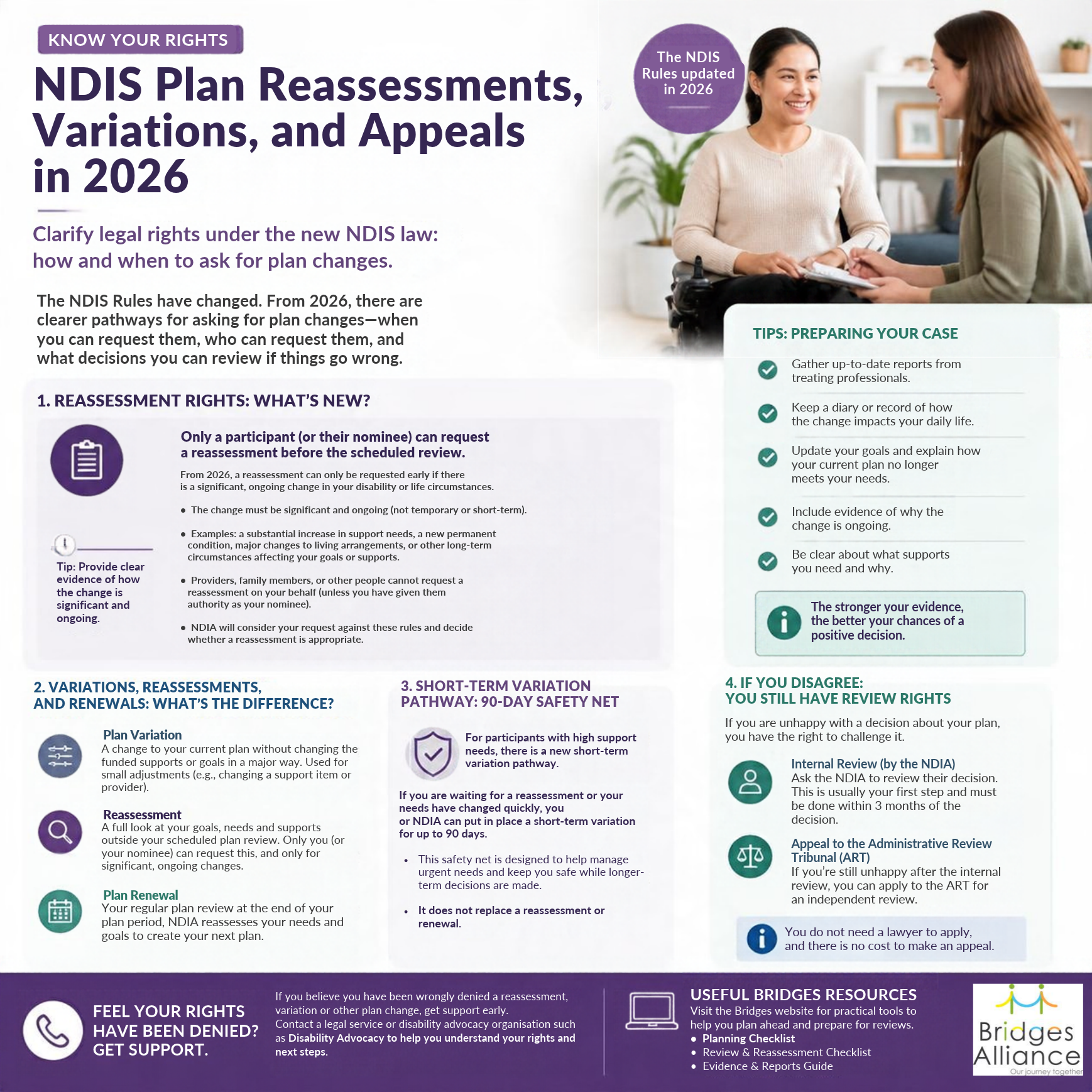
Starting in 2026, changes to the NDIS laws affect how and when you can change your NDIS plan. Only you, your plan nominee or child representative (if applicable) can ask the NDIA for an unscheduled plan reassessment when your support needs significantly and ongoingly change. This guide explains the difference between plan reassessments, variations, and renewals, plus how to challenge decisions through internal reviews and appeals.
Plan Reassessment: When to Ask for a New Plan
A plan reassessment means getting a whole new NDIS plan because your support needs have changed substantially. You would request a reassessment if an ongoing change in your disability or life situation means your current plan no longer meets your needs – for example, needing more home care hours after a health decline, or starting a new course of study. Unlike minor tweaks, reassessments involve a full review of your supports and budgets.
Under the new rules, you must use the official reassessment request form and provide evidence of the change. Importantly, only you (the participant), your nominated representative, or child representative can submit this form. Providers or family members cannot do it on your behalf without this consent. The form should clearly explain what changed and why your plan should be updated, and include recent documentation (reports or letters) from health or disability professionals confirming your changed needs. For example, a doctor’s report might describe a decline in mobility, or a therapist’s report might explain a new support requirement.
Once the NDIA has your reassessment request, they aim to make a decision within 90 days. They will let you know whether they will:
Reassess your plan (create a new plan with adjusted budgets/supports),
Vary your plan (make partial changes without a full reassessment), or
Refuse reassessment (if evidence doesn’t show a significant change).
You keep using your current plan while this decision is pending. If approved, a new plan will be developed. If not approved, you can still ask for minor changes (see plan variation below) or pursue a review of the decision.
Key tips: Before asking for reassessment, gather up-to-date evidence of your support needs. Write down how many hours of help you currently need each day, and from whom; describe any goals or activities you can’t do without more support; and collect recent reports (medical, therapy, school or carer reports) that confirm these needs. Be prepared to give a detailed picture of your daily life and challenges – this will help the assessor understand why a new plan is justified.
Plan Variation: For Urgent, Short-Term or Minor Changes
A plan variation is when you ask the NDIA to adjust part of your existing plan without replacing it entirely. Variations are for smaller or urgent changes that don’t require a full reassessment. Examples include fixing an error in your plan, adding a recommended assistive device, changing a goal, or arranging crisis funding.
You (or your nominee/child rep) can request a variation at any time for urgent or short-term needs. For instance, if you suddenly need extra therapy for a few weeks, or your plan forgot an item your therapist recommended, a variation can address that quickly. The NDIA also uses variations to adjust the reassessment date or correct minor mistakes.
To request a variation, you can complete the “Plan Variation Request Form” or simply contact the NDIA directly. You should explain what change you need and why. You may need to provide evidence (for example, a short therapy report or a risk assessment). Once the NDIA has your request, they aim to make a decision within 21 days. If approved, you’ll get an updated plan (or page) with the change. If not approved, they’ll explain why and you could ask for a reassessment instead.
If you have high support needs (24/7 disability supports) and a new plan’s budget reductions would jeopardize your safety, there’s a special variation pathway. This is sometimes called the high support needs variation or 90-day safety net. If you meet the criteria (typically a very high total budget and round-the-clock supports), you can ask the NDIA to increase certain support budgets within 90 days of your plan starting. The NDIA will first check if you qualify (within 21 days), then decide on the funding increase (another 21 days). This ensures you have a short-term “safety net” if your plan’s cuts would leave you without essential care.
Who can ask: You, your nominee or child rep can request a variation. (Others, like support coordinators, need your consent.)
Plan Renewal (Scheduled Review)
A plan renewal (or scheduled review) happens on the date set in your plan (usually 1–2 years). It’s when the NDIA reviews your plan by default. Under the new rules, most plans are multi-year with fewer mandatory reviews. You should prepare for your scheduled plan meeting by the same methods above. If no significant changes occur, your plan will simply continue or be renewed for the next period.
Gathering Evidence and Preparing
For any plan change request, having strong documentation is crucial. Keep recent reports or assessments from doctors, therapists, or educators. Maintain a diary or log of daily support tasks (for example, how often you need help showering, dressing, or with mobility). List all the supports you use (family, community services, formal NDIS supports) and how you achieve your goals with them. All of this detailed information can go into your reassessment request. Evidence must be recent (usually within the last 4 months) and clearly tied to your disability.
Discuss your needs early with your LAC or support coordinator. Under the new model, your voice is more important than ever – you should drive the conversation about your needs and goals. Don’t hesitate to explain if something in your life has changed (like a new medical diagnosis or living situation). Getting ready well before you submit a request will make the process smoother.
What If Your Request Is Denied: Review and Appeal Rights
Even with all preparations, you might disagree with an NDIA decision. Don’t panic – you have rights to challenge it. Under the new rules, the review pathway remains the same: you can ask for an internal review, and if you’re still unhappy, you can appeal to the Administrative Appeals Tribunal (AAT).
Internal Review: Request in writing (NDIA provides a form) within 3 months of getting the decision. This could be a review of a reassessment refusal, a plan variation denial, or any planning decision. You’ll want to provide any additional evidence or clarification. The NDIA aims to complete internal reviews within 60 days of receiving your request, and they will give you written reasons for the outcome. You can only ask for one internal review of the same decision, so make it count by being thorough.
AAT Appeal: If the internal review outcome is still unsatisfactory, you can apply to the AAT for an external review. (You must wait until the internal review is finished, and there are strict time limits to apply to the AAT.) The Tribunal will look at all evidence and facts and decide what’s the correct decision under the NDIS Act.
Tip: For both internal reviews and appeals, keep gathering evidence up until you file. If you receive any new medical reports or assessments after the NDIA’s decision, include them. Advocacy services (such as those funded under the National Disability Advocacy Program) can provide free support to prepare review applications.
Take Action: Get Help and Stay Involved
If you feel a decision is wrong, reach out to support immediately. You might contact a disability advocacy organization or legal aid service for advice. Bridges Alliance also offers resources to help NDIS participants prepare: we have planning checklists and host workshops on how to advocate for your NDIS plan. Planning ahead is key – for example, book your next plan meeting or reassessment request well before any deadlines (at least a few months early) to gather the necessary information.
Remember, these new rules are meant to make planning more transparent and participant-led. With thorough preparation and by asserting your rights, you can navigate reassessments, variations, and reviews confidently.
CTA: If you need guidance, consider joining our Bridges Alliance NDIS Planning Workshop (registration link) or download our free NDIS Planning Checklist. And if the NDIA has declined a change you believe you deserve, contact your local disability advocacy service or an NDIS appeals advocate for free help. You don’t have to face NDIS challenges alone – ask for support and use your review rights to get the plan you need.
FAQ
What’s the difference between a plan reassessment and a plan variation? A plan reassessment gives you a whole new plan because your needs have significantly changed. A plan variation just tweaks part of your existing plan for minor or urgent changes (e.g. adding an item or adjusting a goal). Variations are faster (NDIA decides in ~21 days) than reassessments.
Who can ask for a plan reassessment or variation? Only the participant themselves, their registered nominee, or their child representative can make these requests. Family or providers need your permission (or to be your nominee) to act for you.
What evidence do I need for a reassessment? You’ll need recent reports or letters from GPs, specialists, therapists or other professionals that clearly show a significant and ongoing change to your support needs. For example, a doctor’s letter confirming increased health care needs, or an OT assessment recommending new supports. It’s best if the evidence is dated within 4 months of your request and after your current plan started.
Can I vary my plan if I’m waiting for a reassessment? Yes. If you have an urgent or short-term need (for example, unexpected therapy or a safety issue), ask for a plan variation immediately, even while a reassessment is pending. Variations are not limited by timing – you can request them anytime.
What if the NDIA refuses to reassess or vary my plan? You can request an internal review of that decision within 3 months. Provide additional evidence or clarifications in your request. The NDIA should finish this review in 60 days. If you still disagree after that, you can apply to the AAT for an external appeal.
When is the 90-day deadline for high support variations? If your plan was approved with very high support funding, you have 90 days from the plan’s start date (when the “support determination” was applied) to ask for a high-support variation. After 90 days, this special variation pathway is no longer available.
Are there any new decision timelines? Yes. For unscheduled reassessments, NDIA now has 90 days to decide once it has your full application. For plan variations, the NDIA aims to decide within 21 days. Always factor in these timelines when planning your requests.
Can I still have a regular plan review? Yes. Scheduled plan reviews (renewals) will continue at the dates set in your plan. The main changes are about unscheduled (mid-term) reviews. You should still prepare for your regular plan meeting by gathering evidence and thinking about your goals.
Answer Engine Optimisation (AEO) Text: Under the new 2026 NDIS law, only a participant or their authorised representative can request an unscheduled plan reassessment for significant changes. This post explains the difference between plan variations (for minor/urgent changes) and reassessments (for bigger changes) with NDIA decision timelines. It also covers the 90-day high support needs variation option and reminds participants of their right to internal NDIA review and AAT appeals if plans aren’t updated fairly. Practical tips on gathering evidence and action steps are provided.
Geographic (GEO) Text: Bridges Alliance (NSW) guides Australian NDIS participants on how to navigate the new 2026 NDIS planning rules. This article helps Sydney and NSW participants understand their rights to plan reassessment, variation, and appeals under updated NDIS laws.
