New to the NDIS?
Start here.
Understanding the National Disability Insurance Scheme (NDIS)
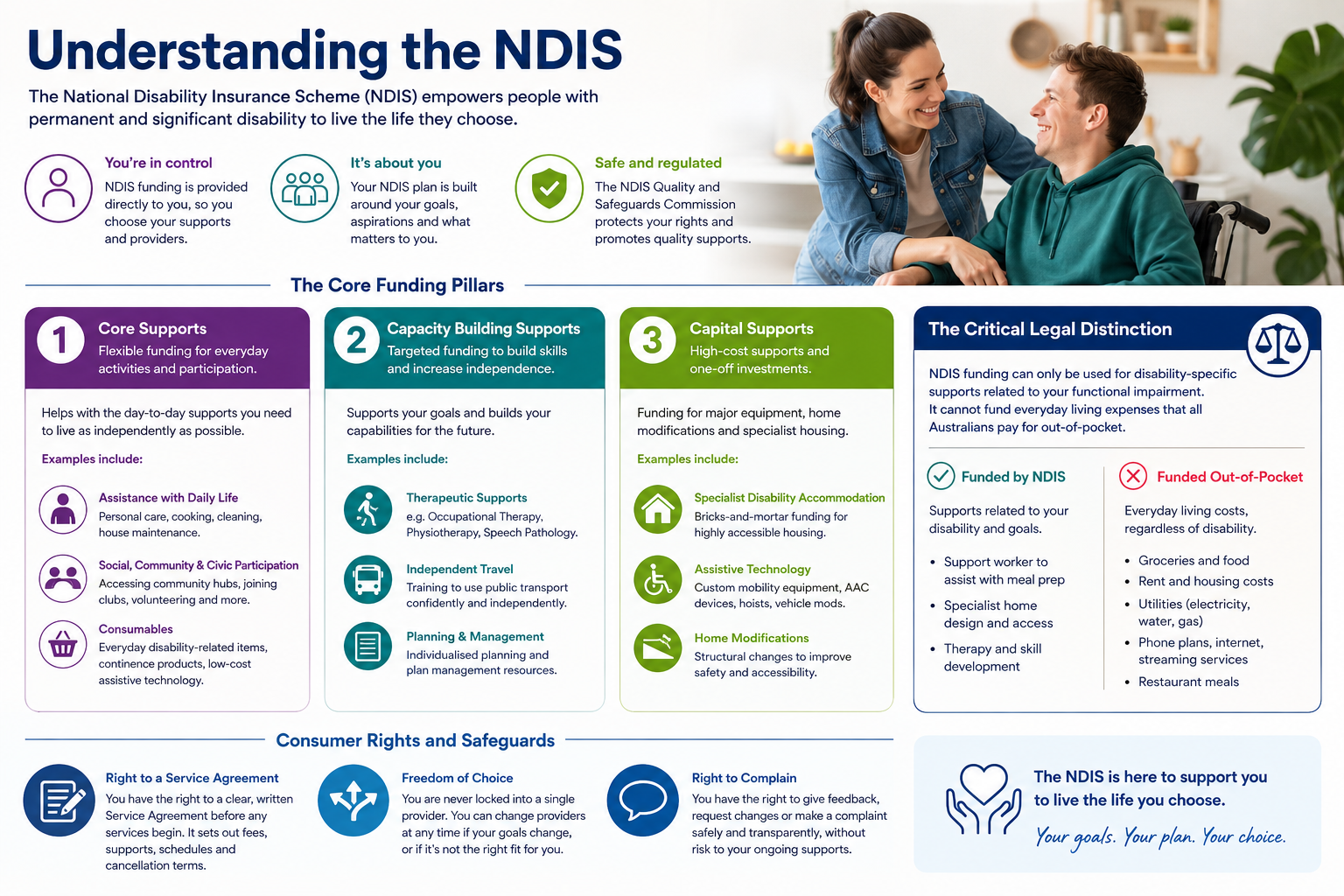
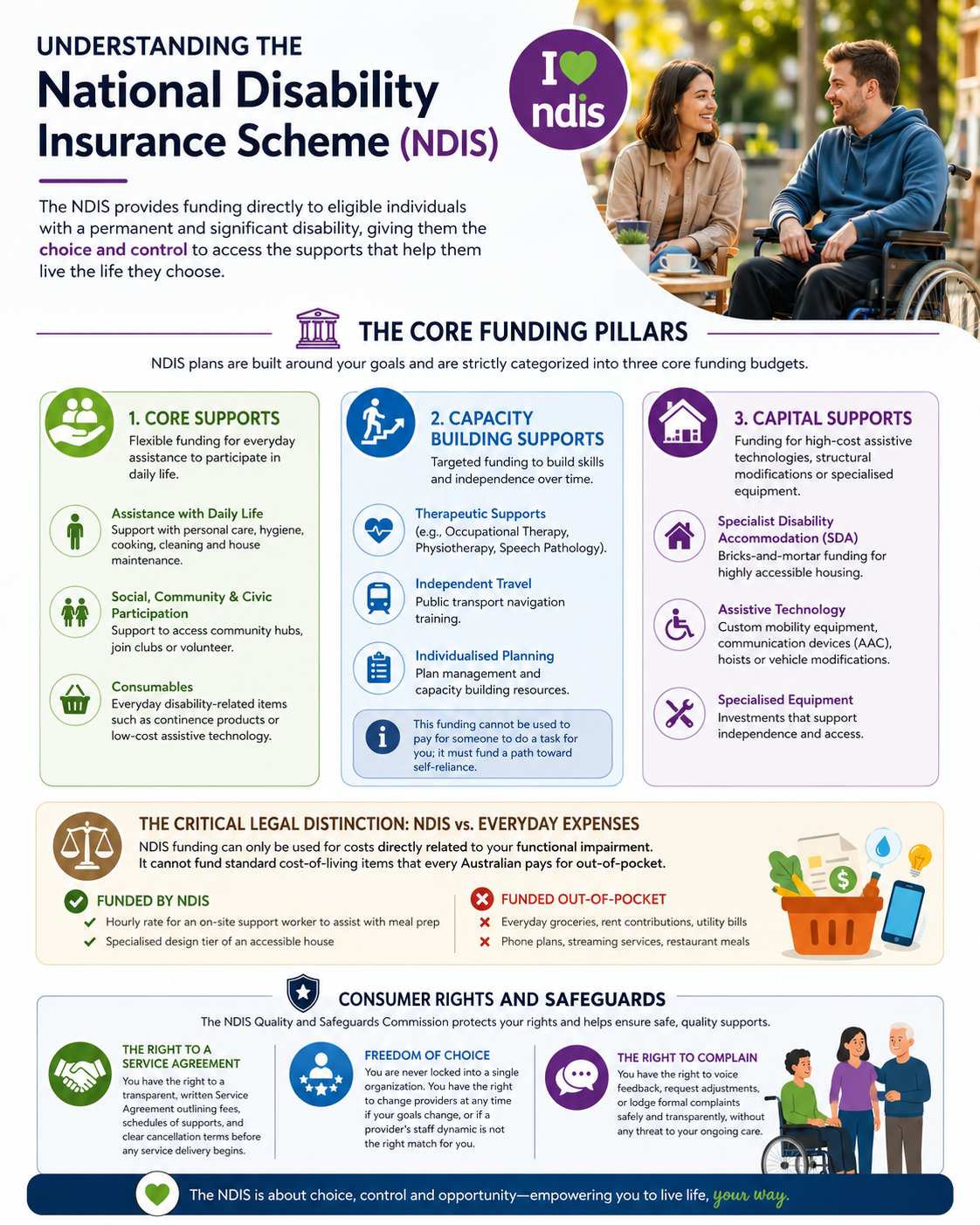
The National Disability Insurance Scheme (NDIS) is Australia’s national framework designed to provide direct funding to individuals with a permanent and significant disability. Managed by the National Disability Insurance Agency (NDIA), the scheme rejects outdated, block-funded welfare models, opting instead for a participant-centered marketplace that champions individual choice and control.
Rather than funding organizations directly, the NDIS provides funding directly to eligible individuals, allowing them to choose which providers they work with and how their supports are delivered.
The Core Funding Pillars
NDIS plans are built around an individual's personal goals and are strictly categorized into three core funding budgets. To maintain regulatory compliance, funds must be spent explicitly within these allocated pillars:
1. Core Supports
This is the most flexible budget category, covering the essential assistance needed to complete everyday activities. It includes:
Assistance with Daily Life: Funding for support staff to assist with personal care, hygiene, cooking, cleaning, and house maintenance.
Social, Community & Civic Participation: Funding for support workers to assist participants in accessing community hubs, joining clubs, or volunteering.
Consumables: Funding for everyday disability-related items, such as continence products or low-cost assistive technology.
2. Capacity Building Supports
This funding is strictly targeted at developing skills and independence over time. Unlike Core supports, Capacity Building funds cannot be used to pay for someone to do a task for you; they must fund a path toward self-reliance. Examples include:
Therapeutic supports (e.g., Occupational Therapy, Physiotherapy, Speech Pathology).
Independent travel and public transport navigation training.
Individualized planning and plan management resources.
3. Capital Supports
This category funds high-cost assistive technologies, structural modifications, or specialized equipment investments. It is strictly evaluated and includes:
Specialist Disability Accommodation (SDA): Bricks-and-mortar funding for highly accessible physical housing layouts.
Assistive Technology: Custom mobility equipment, specialized communication devices (AAC), hoists, or vehicle modifications.
The Critical Legal Distinction: NDIS vs. Everyday Expenses
To safeguard public funds and maintain compliance with National Disability Insurance Scheme legislation, there is an absolute boundary between disability-specific functional supports and standard out-of-pocket costs:
The Everyday Living Expense Rule: NDIS funding can only be utilized for costs directly related to a participant’s functional impairment. It cannot legally fund standard cost-of-living items that every Australian citizen must pay for out-of-pocket, regardless of disability status.
Funded by NDIS: The hourly rate for an on-site support worker to assist with meal prep, or the specialized design tier of an accessible house.
Funded Out-of-Pocket: Everyday groceries, rent contributions, household utility bills (electricity, water, gas), phone plans, streaming services, and restaurant meals.
Consumer Rights and Safeguards
The NDIS Quality and Safeguards Commission operates as an independent regulatory body to improve the safety and quality of all NDIS supports. Under their consumer framework, every participant possesses explicit legal rights:
The Right to a Service Agreement: Before any service delivery begins, you have the right to a transparent, written Service Agreement outlining fees, schedules of supports, and clear cancelation terms.
Freedom of Choice: You are never locked into a single organization. You have the right to change providers at any time if your goals change, or if a provider's staff dynamic is no portfolio match for your personal routine.
The Right to Complain: Participants have the explicit right to voice feedback, request adjustments, or lodge formal complaints regarding service delivery safely and transparently, without any threat to their ongoing care.
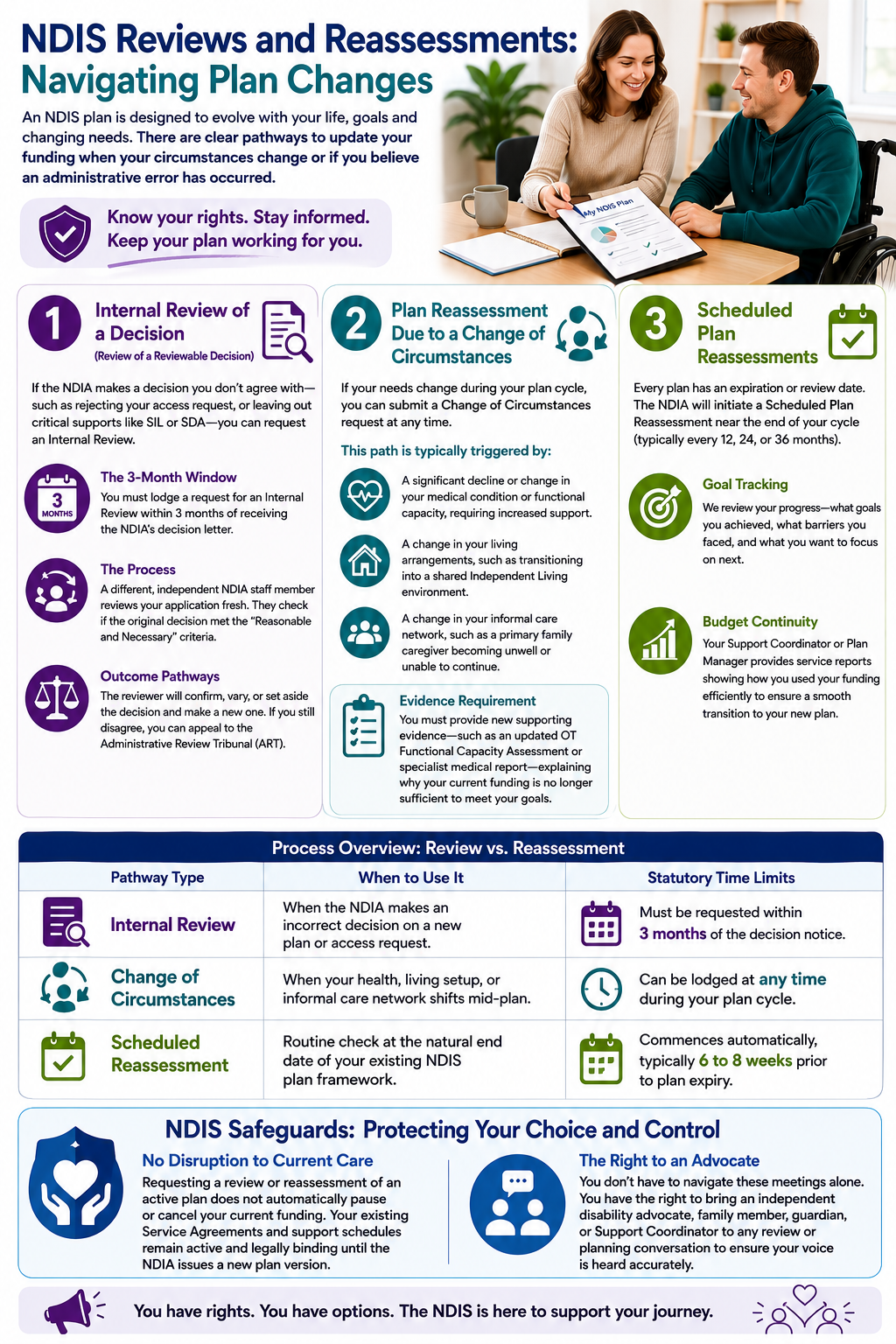
NDIS Funding Categories Explained: Navigating Your Plan Budgets
An NDIS plan is structured around individual goals and functional needs. To manage public funds accountably and protect participant rights, the National Disability Insurance Scheme (NDIS) divides funding into distinct budgets, which are further broken down into specific support categories.
Understanding where your funds are allocated—and which categories are flexible versus fixed—is essential for ensuring compliant, optimized spending.
The Four Main Budget Pillars
Your plan will display up to four main budget types depending on your assessed functional support needs.
                +---------------------------------------+
                |          YOUR NDIS TOTAL PLAN         |
                +---------------------------------------+
                                    |
      +------------------+----------+----------+------------------+
      |                  |                     |                  |
+-----------+     +--------------+     +---------------+    +-----------+
|   CORE    |     |   CAPACITY   |     |    CAPITAL    |    | RECURRING |
|  BUDGET   |     |   BUILDING   |     |    BUDGET     |    |  BUDGET   |
+-----------+     +--------------+     +---------------+    +-----------+
1. Core Supports (The Flexible Everyday Budget)
The Core Supports budget covers the essential items and services required to manage your day-to-day life and maintain functional independence. For most categories under Core, the funding is flexible—meaning you can shift funds from one category to another if your short-term needs change.
Assistance with Daily Life: Funding for support staff to assist or supervise personal care, showering, cooking, and everyday domestic tasks.
Assistance with Social, Economic & Community Participation: Funding for support workers to help you access community hubs, attend recreational activities, or build social connections.
Consumables: Covers necessary everyday disability products, such as continence products, medical dressings, or low-cost assistive technology (under $1,500).
Transport: Funding to cover provider-delivered transport to appointments or social community activities.
2. Capacity Building Supports (The Skill-Building Budget)
The Capacity Building budget is explicitly targeted at developing your personal skills, confidence, and self-reliance. Funds in this budget cannot be used to buy everyday items or pay someone to do a task for you; they must invest in a path toward your long-term independence.
Improved Daily Living: Funds therapeutic assessments and treatments delivered by allied health practitioners (e.g., Occupational Therapy, Speech Pathology, Physiotherapy).
Support Coordination: Time-limited funding to hire a professional to help you coordinate your plan, connect with community networks, and optimize your service delivery.
Improved Relationships: Specialized funding for behavioral support plans or social skill building programs.
Finding and Keeping a Job: Employment-focused training, resume building, and work experience support.
Improved Life Choices: Specific funding to cover the costs of a professional Plan Manager to handle your bookkeeping and provider payments.
3. Capital Supports (The High-Value Infrastructure Budget)
Capital supports cover expensive, one-off specialized equipment and major structural investments. This budget is strictly fixed (not flexible) and generally requires independent quotes and clinical assessments before funds are released by the NDIA.
Assistive Technology: Funding for high-cost mobility equipment (e.g., customized wheelchairs, communication devices, or specialized hoists).
Home Modifications: Physical structural changes to your environment, such as accessible bathroom renovations, ramp installations, or handrails.
Specialist Disability Accommodation (SDA): Structural "bricks and mortar" capital funding required for highly accessible physical housing designs.
4. Recurring Supports (The Direct Allowance Budget)
This is a dedicated, separate line-item meant for automated, ongoing regular payments. For instance, instead of requiring you to lodge individual taxi receipts, the NDIA deposits a set transport allowance directly into your bank account at scheduled intervals to subsidize travel costs.
Flexible vs. Stated Supports: A Critical Compliance Rule
Even within a flexible budget like Core, the NDIS utilizes a strict rule to ensure critical needs are legally safeguarded:
Flexible Supports: You have the autonomy to move funding between categories (e.g., spending less on community participation one week to buy necessary continence consumables) as long as they share the same fund management type.
Stated Supports: If a line-item is labeled as "Stated" in your plan, it is legally locked. It cannot be used for any other support type. For example, Supported Independent Living (SIL) or specialized Home and Living allocations are always classified as Stated Supports to protect your residential stability.
Consumer Rights & Spending Framework
The NDIS Quality and Safeguards Commission reminds participants and providers that all plan spending must strictly align with the legal NDIS funding criteria. For a support purchase to be compliant, it must be:
Directly related to your recognized disability impairment.
Value for money and clear of everyday, standard lifestyle costs (such as basic groceries, rent, utility bills, or holiday packages).
Effective and clinically beneficial to your development.
If you are ever unsure about how your categories interact, your Plan Manager or Support Coordinator can provide detailed budget insights before you sign your provider service agreements.
NDIS Terminology Explained: A Guide to Key Concepts
Navigating the National Disability Insurance Scheme (NDIS) involves learning a specific set of terms, acronyms, and operational phrases. To support your self-advocacy and ensure you retain full choice and control, here is a professional breakdown of the most common NDIS terminology used by the National Disability Insurance Agency (NDIA) and service providers.
1. Governance & Management Roles
NDIA (National Disability Insurance Agency): The independent Commonwealth government agency responsible for assessing eligibility, managing funding allocations, and administering the scheme overall.
NDIS Quality and Safeguards Commission: The independent regulatory body that oversees provider registration, handles formal complaints, enforces safety modules, and protects participant rights.
Participant: An individual with a permanent and significant disability who has met the access criteria and holds an approved NDIS plan.
Nominee / Guardian: A person legally appointed to act or make decisions on behalf of a participant regarding their NDIS plan when required.
Support Coordinator: A funded professional who assists participants in understanding their plan budgets, connecting with community networks, and executing service agreements.
Plan Manager: An independent, funded service provider responsible for managing a participant's NDIS financial bookkeeping, processing invoices, and balancing category budgets.
2. Plan & Funding Structures
Choice and Control: The foundational legal principle of the NDIS guaranteeing that participants have the absolute right to decide who supports them, how services are delivered, and where they live.
Reasonable and Necessary: The legislative criteria the NDIA uses to determine what supports can be funded. A support must be value for money, directly related to the disability, effective, and separate from everyday standard living costs.
Everyday Living Expenses: Out-of-pocket costs that all citizens must pay regardless of disability (e.g., groceries, rent, utilities, cafe meals). These cannot legally be funded by the NDIS.
Stated Support: A highly specific funding line-item that is legally locked to a designated service (e.g., Supported Independent Living). It cannot be shifted or spent on any other support category.
3. Housing & Daily Living Categories
SIL (Supported Independent Living): Funding centered around person-to-person care. It pays for support staff to assist with daily tasks, personal hygiene, cooking, and capacity-building skills inside the home environment.
SDA (Specialist Disability Accommodation): Capital funding that pays strictly for the physical "bricks and mortar" infrastructure of a home. It features specialized accessibility modifications for individuals with extreme functional impairments.
ILO (Individualised Living Options): A flexible, relationship-focused alternative to SIL that combines formal paid drop-in services with informal personal networks (like co-residents or host arrangements).
Roster of Care (RoC): A structured weekly spreadsheet mapping out exactly when a participant shares support workers with housemates versus when they receive dedicated 1:1 attention.
Quick Reference: Core vs. Capacity Building vs. Capital
All funded items fall into one of these three primary umbrellas:
Budget PillarOperational MeaningDirect ExampleCore Supports
Flexible funding for everyday essential activities and assistance.
Hourly support worker for personal hygiene or community access.
Capacity Building
Fixed skill-building funding meant to progressively grow independence.
Occupational Therapy assessments or independent travel training.
Capital Supports
Fixed infrastructure funding for high-cost equipment or home designs.
Customized wheelchairs, ceiling hoists, or SDA property enrollments.
4. Operational Actions & Rights
Service Agreement: A transparent, written contract signed between a participant and a provider before any care is delivered. It details costs, the schedule of supports, and clear cancelation terms.
Functional Capacity Assessment (FCA): A comprehensive report compiled by an allied health professional (typically an Occupational Therapist) evaluating your physical, cognitive, and sensory support needs.
Internal Review: A formal request lodged within 3 months of an incorrect NDIA decision, forcing an independent staff member to review the application entirely fresh.
Change of Circumstances (CoC): A dynamic application pathway utilized when a participant's health, living arrangements, or informal family supports shift unexpectedly mid-plan.
How to Apply for NDIS Funding: A Step-by-Step Access Pathway
Applying for the National Disability Insurance Scheme (NDIS) is a structured, evidence-based legal process. To ensure your application is assessed efficiently by the National Disability Insurance Agency (NDIA), you must systematically demonstrate that you meet the specific age, residency, and disability requirements.
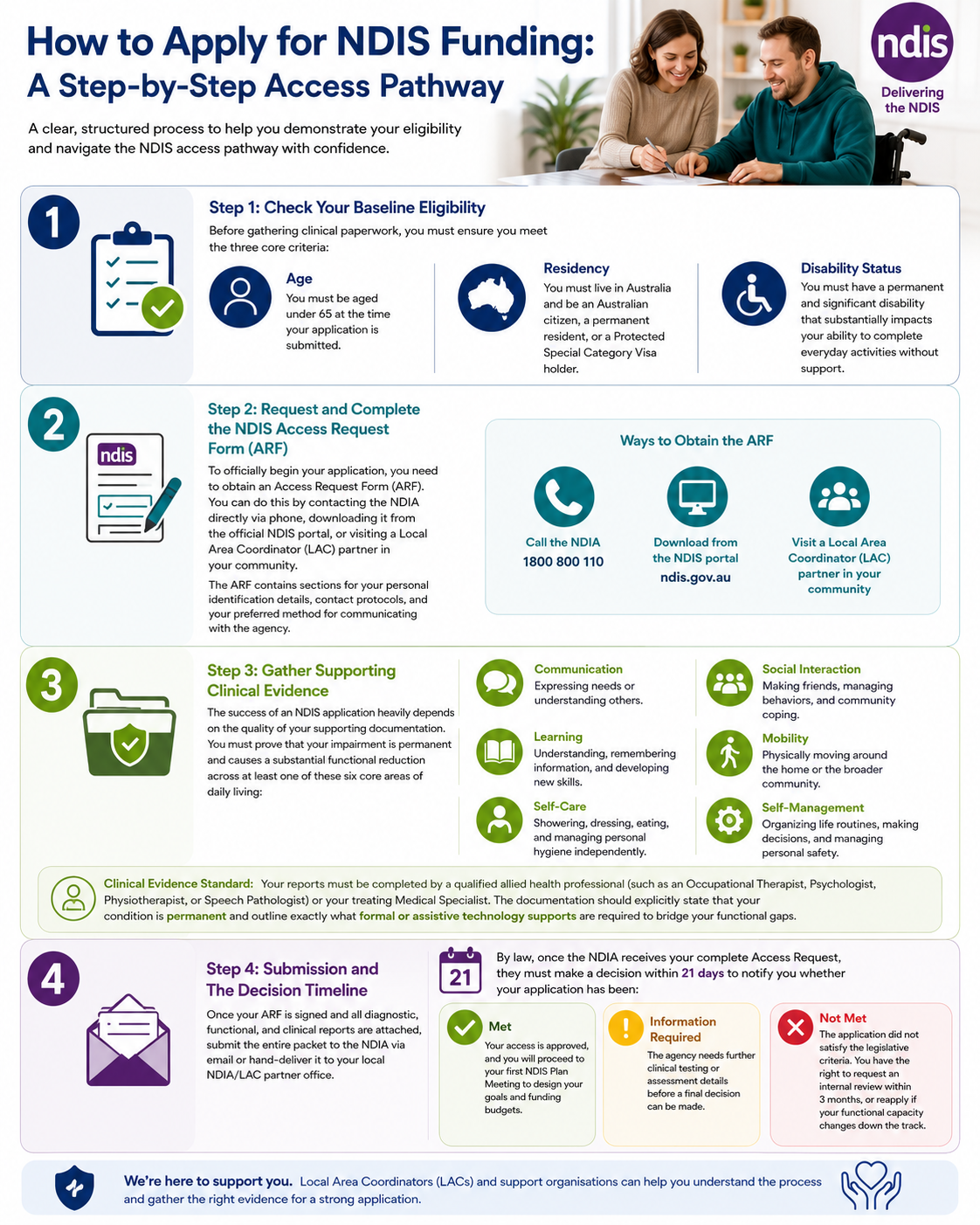
The application workflow is broken down into four key operational stages:
Step 1: Check Your Baseline Eligibility
Before gathering clinical paperwork, you must ensure you meet the three core criteria:
Age: You must be aged under 65 at the time your application is submitted.
Residency: You must live in Australia and be an Australian citizen, a permanent resident, or a Protected Special Category Visa holder.
Disability Status: You must have a permanent and significant disability that substantially impacts your ability to complete everyday activities without support.
Step 2: Request and Complete the NDIS Access Request Form (ARF)
To officially begin your application, you need to obtain an Access Request Form (ARF). You can do this by contacting the NDIA directly via phone, downloading it from the official NDIS portal, or visiting a Local Area Coordinator (LAC) partner in your community.
The ARF contains sections for your personal identification details, contact protocols, and your preferred method for communicating with the agency.
Step 3: Gather Supporting Clinical Evidence
The success of an NDIS application heavily depends on the quality of your supporting documentation. You must prove that your impairment is permanent and causes a substantial functional reduction across at least one of these six core areas of daily living:
Communication: Expressing needs or understanding others.
Social Interaction: Making friends, managing behaviors, and community coping.
Learning: Understanding, remembering information, and developing new skills.
Mobility: Physically moving around the home or the broader community.
Self-Care: Showering, dressing, eating, and managing personal hygiene independently.
Self-Management: Organizing life routines, making decisions, and managing personal safety.
Clinical Evidence Standard: Your reports must be completed by a qualified allied health professional (such as an Occupational Therapist, Psychologist, Physiotherapist, or Speech Pathologist) or your treating Medical Specialist. The documentation should explicitly state that your condition is permanent and outline exactly what formal or assistive technology supports are required to bridge your functional gaps.
Step 4: Submission and The Decision Timeline
Once your ARF is signed and all diagnostic, functional, and clinical reports are attached, submit the entire packet to the NDIA via email or hand-deliver it to your local NDIA/LAC partner office.
By law, once the NDIA receives your complete Access Request, they must make a decision within 21 days to notify you whether your application has been:
Met: Your access is approved, and you will proceed to your first NDIS Plan Meeting to design your goals and funding budgets.
Information Required: The agency needs further clinical testing or assessment details before a final decision can be made.
Not Met: The application did not satisfy the legislative criteria. If this occurs, you possess explicit consumer rights to request an internal review of the decision within 3 months, or you can reapply if your functional capacity changes down the track.
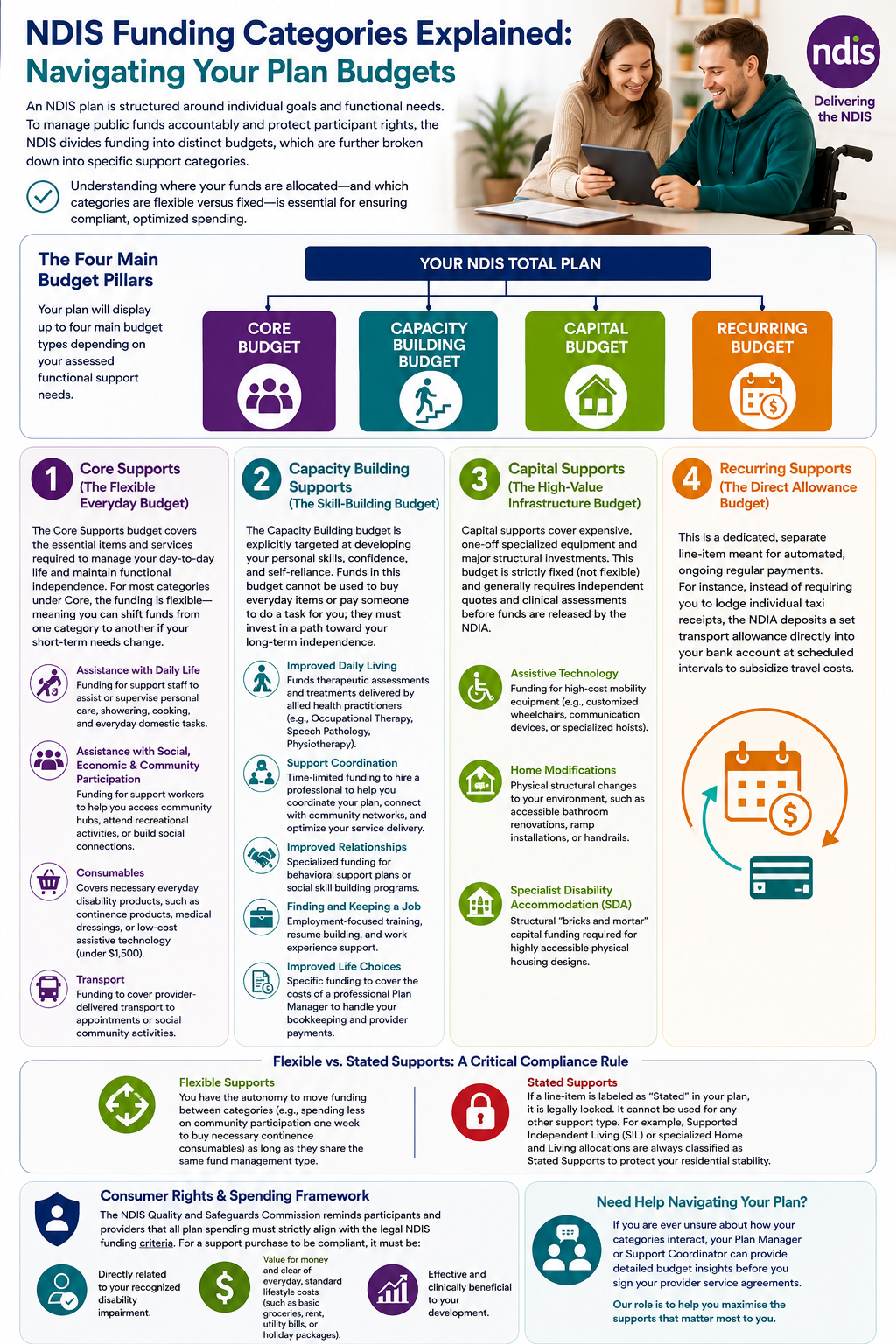
NDIS Reviews and Reassessments: Navigating Plan Changes
An NDIS plan is designed to be a dynamic document that evolves alongside your life stages, goals, and changing functional requirements. Under the National Disability Insurance Scheme (NDIS), there are clear, legislated pathways to update your funding when your circumstances change or if you believe an administrative error has occurred.
Understanding the difference between an Internal Review, a Change of Circumstances Reassessment, and a Scheduled Plan Reassessment is essential for maintaining funding stability and protecting your rights.
1. Internal Review of a Decision (Review of a Reviewable Decision)
If the National Disability Insurance Agency (NDIA) makes a formal decision that you do not agree with—such as rejecting your initial access request, or leaving out critical funded lines like SIL or SDA—you have the legal right to request an Internal Review.
The 3-Month Window: You must lodge a request for an Internal Review within 3 months of receiving the NDIA's initial decision letter.
The Process: A different, independent staff member within the NDIA who was not involved in the original decision will look at your application fresh. They will evaluate whether the original decision met the legislated "Reasonable and Necessary" criteria.
Outcome Pathways: The reviewer will either confirm the original decision, vary it, or set it aside and make a completely new decision. If you still disagree with the outcome of the internal review, you have the right to appeal to the Administrative Review Tribunal (ART).
2. Plan Reassessment Due to a Change of Circumstances
If your plan was initially correct, but your everyday life or support needs change unexpectedly during your plan cycle, you can submit a Change of Circumstances request at any time.
This path is typically triggered by major life events, such as:
A significant decline or change in your medical condition or functional capacity, requiring increased support hours.
A change in your living arrangements, such as transitioning into a shared Independent Living environment.
A change in your informal care network, such as a primary family caregiver becoming unwell or sustainably unable to continue providing unpaid care.
Evidence Requirement: When submitting a Change of Circumstances request, you must provide new supporting evidence—such as an updated Occupational Therapy (OT) Functional Capacity Assessment or a specialist medical report—explicitly detailing why your current funding is no longer sufficient to meet your goals.
3. Scheduled Plan Reassessments
Every NDIS plan has an expiration or review date. As you approach the end of your plan cycle (typically every 12, 24, or 36 months), the NDIA will initiate a Scheduled Plan Reassessment.
Goal Tracking: This meeting focuses on evaluating your progress. You will look at what goals you achieved, what barriers you faced, and what outcomes you want to focus on for your next plan cycle.
Budget Continuity: Your Support Coordinator or Plan Manager will help you pull together service reports showing how you utilized your previous funding efficiently. This helps ensure your baseline daily living supports flow smoothly into your new budget without a gap in care.
Process Overview: Review vs. Reassessment
Pathway TypeWhen to Use ItStatutory Time Limits
Internal Review
When the NDIA makes an incorrect decision on a new plan or access request.
Must be requested within 3 months of the decision notice.
Change of Circumstances
When your health, living setup, or informal care network shifts mid-plan.
Can be lodged at any time during your plan cycle.Scheduled ReassessmentRoutine check at the natural end date of your existing NDIS plan framework.Commences automatically, typically 6 to 8 weeks prior to plan expiry.
NDIS Safeguards: Protecting Your Choice and Control
The NDIS Quality and Safeguards Commission protects your right to self-advocacy throughout any review or reassessment process.
No Disruption to Current Care: Requesting a review or a reassessment of an active plan does not automatically pause or cancel your current funding. Your existing Service Agreements and support schedules remain active and legally binding until the NDIA officially issues a new plan version.
The Right to an Advocate: You do not have to navigate these meetings alone. You have the explicit right to bring an independent disability advocate, a family member, a guardian, or your Support Coordinator into any review or planning conversation to ensure your voice is heard accurately.